Don't Get Scammed: Wire Fraud and Real Estate Scams Targeting Houston Buyers
How wire fraud, deed theft, and fake listings work, and the simple steps that protect your money.
August 18, 2026 | Raquel Refuerzo
As of January 1, 2026, anyone filing a deed or property document in person in Texas has to show a photo ID, and county clerks now have to flag suspected fraud to law enforcement. That change came from Senate Bill 16, a law the Legislature passed specifically because criminals were stealing Houston-area homes on paper, with forged documents, before owners ever knew anything was wrong. The state does not pass a law like that unless the problem is real and growing.
It is. The FBI's most recent Internet Crime Report logged $275.1 million in real estate fraud losses across 12,368 complaints in a single year, a sharp jump from roughly $173 million the year before. Behind every one of those numbers is a buyer or homeowner who did almost everything right and lost money at the worst possible moment, often their entire down payment, often unrecoverable.
The good news: the scams that target Houston buyers follow predictable patterns, and the defenses are simple. You do not need special software or a security background. You need to know what the traps look like and slow down at three or four specific moments. This guide walks through the three biggest threats, plus the smaller cons that ride alongside them, and exactly what to do at each step.
Quick Takeaways
- Wire fraud is the costliest scam in real estate. A hacked email account leads to fake "updated" wire instructions days before closing. Once you wire the money, it is usually gone for good.
- Always verify wire instructions by phone using a number you already had, not one from the email. Call the title company and confirm the account number out loud before sending a dime.
- Deed theft is rising in Harris County. Forged documents transfer your home to a stranger, who then sells or refinances it. Texas Senate Bill 16 now makes it a specific felony offense.
- Sign up for Harris County's free Property Fraud Alert so you get notified the moment any document is recorded against your name or property.
- Fake and hijacked listings target renters and buyers with below-market prices and pressure to send a deposit fast. Cross-check every listing on HAR.com.
- Speed is your enemy and the scammer's friend. Real estate professionals will never rush you to wire money or pay a deposit on a property you have not verified.
Why Houston Buyers Are Prime Targets
Scammers go where the money moves fast and the buyers are distracted. Houston checks every box. It is one of the largest housing markets in the country, transactions close at high volume, and a constant stream of out-of-state buyers relocating here are wiring large sums to people they have never met in person. Add a tight rental market and rising home prices, and you have ideal conditions for fraud.
First-time buyers are hit hardest. A 2025 industry survey of wire fraud found that more than 1 in 4 buyers and sellers received a suspicious or outright fraudulent communication during their closing, and first-time buyers were roughly three times more likely to actually lose money than experienced ones. That is not because they are careless. It is because they do not yet know what a normal closing is supposed to feel like, so a "small change" to the wire instructions does not set off any alarms.
Texas, California, and Florida consistently report the highest fraud losses in the country, partly because of population and partly because of how much real estate changes hands. If you are buying in the Houston metro, you are statistically in the crosshairs. Treat that as a reason to be deliberate, not a reason to panic.
Wire Fraud at Closing: The Most Expensive Mistake You Can Make
This is the one that wipes people out. Wire fraud in real estate almost always starts with what the FBI calls business email compromise, and it is frighteningly low-tech.
How the scam actually works
A criminal quietly hacks into an email account somewhere in your transaction. It might be the title company, the closing attorney, your real estate agent, or even your own inbox. They do not announce themselves. They sit and read. They learn the property address, the purchase price, the closing date, the names of everyone involved, and the tone people use with each other.
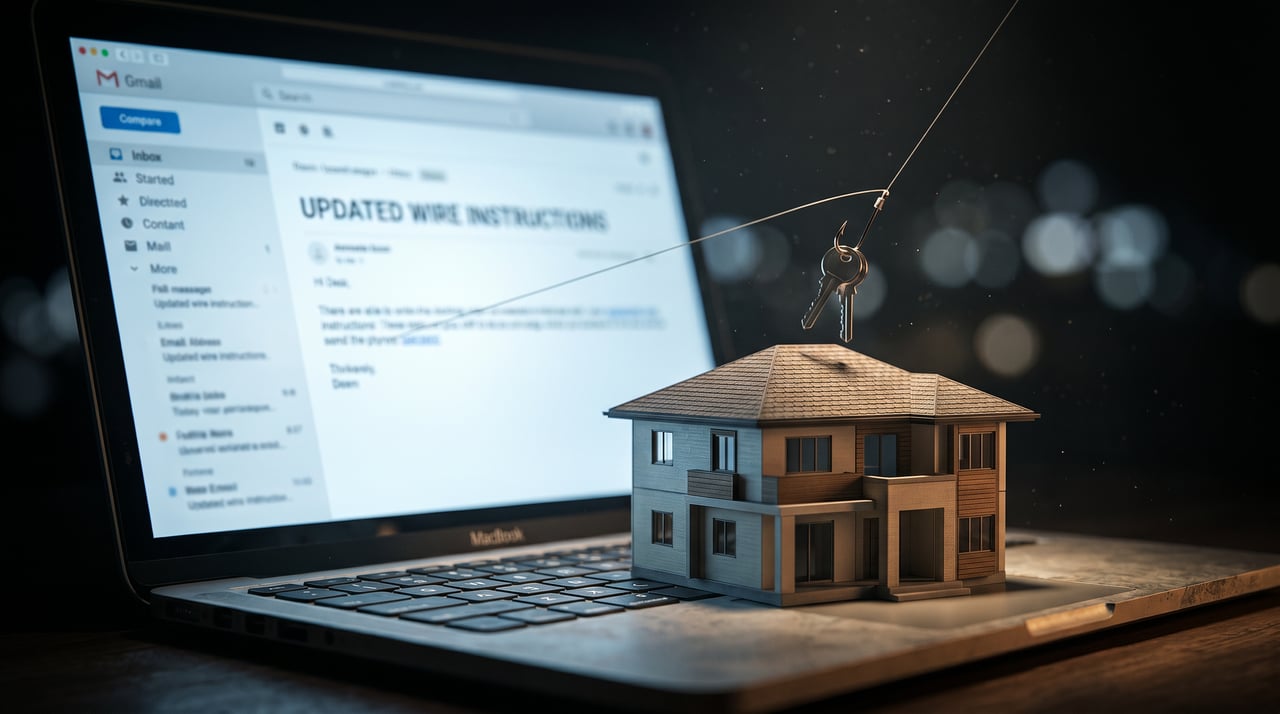
Then, a few days before closing, exactly when you are expecting wire instructions, they send an email that looks completely legitimate. Correct property address. Correct amount. Professional language. The only thing that is wrong is the bank account number, which now belongs to them. The message usually adds urgency: "Our account information has changed, please use these updated instructions," or "We need your funds by 2 PM today or closing will be delayed."
You wire your down payment. Within hours the money is routed through a chain of accounts and is effectively gone. In one case the FBI detailed, a buyer trying to close received a spoofed email from a "title company" with instructions for $1.3 million, and the same fraudulent account was simultaneously being used to target a city government for a separate $6 million.
How to protect your money, step by step
None of these steps require technology. They require a pause at the right moment.
- Get wire instructions early and verbally. Ask your title company at the start of the transaction how the wire process will work and confirm they will not change instructions by email. Many Houston title companies now use secure portals instead of email for exactly this reason.
- Call to verify before you send, every single time. Use a phone number you already have from a business card, the company website, or your signed contract. Never call the number in the email requesting the wire. Read the account number and routing number back out loud and confirm them.
- Treat any "change" as a red flag. Legitimate wire instructions almost never change at the last minute. A sudden update is the single most common sign of fraud.
- Verify the wire landed. Call the title company within a few hours of sending to confirm they received your funds. Catching a mistake the same day is the difference between recovery and total loss.
Understanding the normal flow of money in a Texas closing makes the abnormal obvious. If you want a clear picture of what should happen on closing day, read What Happens at Closing in Texas and Understanding Earnest Money in Houston Real Estate so you know who is supposed to be holding your money and when.
Deed Theft: How Someone "Steals" Your Home on Paper
Wire fraud targets your cash. Deed theft targets the house itself, and it has been climbing fast across Harris County.
How it works
A criminal forges a deed or other conveyance document that transfers ownership of a property into their name or a shell entity they control. They file it with the county. Under the old rules, clerks were largely required to record almost anything submitted, even questionable documents. Once that fraudulent transfer is on record, the scammer "sells" the property to an unsuspecting buyer or takes out a loan against it, then disappears long before the real owner finds out.
The targets are predictable: vacant homes, raw land, rental properties, and homes owned by elderly or deceased owners, because nobody is watching the title day to day. Owners often do not discover the theft for months or even years, sometimes only when a stranger shows up or a tax notice arrives in the wrong name.
Texas finally made it a specific crime
For years, deed fraud was hard to prosecute because no statute was built for it. That changed in 2025. Texas Senate Bill 16 created two new felony offenses, real property theft and real property fraud, with a ten-year statute of limitations and mandatory restitution that can include the property's value, legal fees, and related damages. Penalties are harsher when the victim is elderly, disabled, or a nonprofit.
Just as important, SB 16 added prevention at the point of filing. As of January 1, 2026, anyone recording a property document in person must present a photo ID, and the clerk records that information. If a clerk suspects a filing is fraudulent, they are now required to notify law enforcement. Title professionals have called the ID requirement a potential game changer, because it forces a real person with a real identity to stand behind a filing.
Two free protections every Houston homeowner should use
- Enroll in Harris County's Property Fraud Alert. The Harris County Clerk offers a free service that monitors your name and notifies you whenever a document is recorded against it. You can register your own property and also your aging parents' or family members' properties. If you ever get an alert for a document you did not authorize, you can contact the Clerk's office immediately to start challenging it. This is the single most effective free defense against deed theft.
- Carry an owner's title insurance policy. In Texas, title insurance protects your ownership against forged deeds, fraud, and defects in the chain of title. A lender's policy protects the bank, not you, so the owner's policy is the one that protects your equity if a fraudulent claim surfaces. For a plain-English breakdown of what it covers, see What Is Title Insurance in Texas and Do You Need It.
It is also worth periodically searching your own property in the Harris County Appraisal District records to confirm you are still listed as the owner. A quarterly check takes five minutes and catches problems early.
Fake and Hijacked Listings: The Scam That Hits Before You Even Make an Offer
Not every scam waits for closing. Many start the moment you begin your search, and Houston's tight rental and entry-level market makes them especially common right now.
How it works
Scammers copy real photos, descriptions, and details from a legitimate listing, then repost it on another site with their own contact information swapped in. When you reach out, you are talking to a criminal, not the real agent or owner. The property is usually priced noticeably below market to hook you. They cannot meet in person, often claiming to be out of town or out of the country, and they push you to send a deposit, application fee, or first month's rent fast to "hold" it. Once you pay, they vanish, and the listing disappears.
A variation hits buyers under contract: a fake escrow company or spoofed account convinces you to deposit earnest money into a fraudulent account that gets emptied immediately. Others pose as licensed agents without real credentials and ask for upfront fees.
Red flags and Houston-specific defenses
- The price is too good. Below-market rent or a deal that seems unusually cheap is the most reliable warning sign.
- They will not meet in person and they rush you. A real Houston agent will show you the property and will never pressure you to wire a deposit on something you have not seen.
- Cross-check every listing on HAR.com. Houston buyers and renters have a major advantage here. If a listing is real, it will appear on HAR with matching agent information. If the details do not line up across sites, walk away.
- Never pay an agent directly. Legitimate transactions run payments through a brokerage's approved accounts or a title company, not a personal Cash App, Zelle, or wire to an individual.
- Search the address. If the same home appears under different "owners" or contacts on multiple sites, it is a scam.
Working with a licensed, established agent removes most of this risk by default, because you are dealing with a verifiable professional and a real brokerage rather than a stranger online. That alone is one of the benefits of working with an experienced Houston real estate agent.
A Quick Map of the Threats
Scam | How it works | Your best defense |
|---|---|---|
Closing wire fraud | Hacked email sends fake "updated" wire instructions before closing | Call a known number and verbally confirm the account before wiring |
Deed theft | Forged document transfers your home on paper | Enroll in Harris County Property Fraud Alert and carry owner's title insurance |
Fake or hijacked listings | Real photos reposted with a scammer's contact info and a low price | Cross-check on HAR.com and never pay an individual directly |
Fake escrow or earnest money diversion | Spoofed account collects your earnest money | Confirm escrow details with your agent and title company by phone |
Fake agents | Unlicensed person asks for upfront fees | Verify the license with TREC before paying anything |
What to Do If You Think You've Been Targeted
If you suspect a fraudulent wire, speed is everything. The window to recover money is measured in hours, not days.
- Call your bank immediately and request a wire recall. Ask specifically about a SWIFT recall or indemnification process. The faster the request, the better the odds.
- Contact the title company so they know the funds were diverted and can stop any further damage.
- File a complaint with the FBI at IC3.gov right away. The FBI's Recovery Asset Team can sometimes freeze fraudulent transfers, and it reports a meaningful success rate when victims report quickly. The agency has frozen hundreds of millions in fraudulent funds this way.
- For a suspected fraudulent deed, contact the Harris County Clerk's office, alert your mortgage lender and title insurer, and consult a Texas real estate attorney about voiding the filing.
Reporting fast does not just help you. It builds the case that helps the next buyer too.
The Bottom Line
Every scam in this guide depends on the same thing: getting you to act fast without verifying. Wire fraud needs you to skip the phone call. Deed theft needs you to never check your title. Fake listings need you to send a deposit before you think. Take that speed away and the whole con collapses.
So build a few habits into your transaction. Verify every wire by phone using a number you already trust. Enroll in Harris County's free Property Fraud Alert. Cross-check listings on HAR.com. Buy the owner's title policy. And work with people you can actually verify, from your agent to your title company. If you want a clearer sense of the mistakes that trip buyers up beyond fraud, 5 Mistakes Houston Home Buyers Make and the 10-Step Home Buying Guide for Houston are good next reads.
Houston real estate moves fast. Your money does not have to. A single phone call at the right moment is often the only thing standing between a normal closing and a six-figure loss, and that call is always worth making.
If you are buying or selling in the Houston area and want a professional in your corner who treats your money like it is their own, reach out to Raquel at 832-415-9228 or realtyraquel.com.
Related Keywords:
real estate wire fraud, Houston home buying scams, deed theft Texas, protect earnest money, closing wire fraud prevention