What's My Houston Home Worth in 2026?
How home values are really calculated, why online estimates miss, and how to get an accurate number.
September 17, 2026 | Raquel Refuerzo
You typed your address into Zillow, watched a number pop up, and felt either a small thrill or a sinking feeling. Either way, that number is probably wrong. Not because the technology is bad, but because the most important question in real estate, what a real buyer will actually pay for your specific home in your specific neighborhood this season, is not something an algorithm can answer from a desk in another state.
Houston makes this even trickier than most markets. We have no zoning, a patchwork of deed restrictions, flood maps that redraw value block by block, and price-per-square-foot figures that swing wildly from one ZIP code to the next. An automated estimate flattens all of that into a single confident-looking dollar amount. The real number lives underneath it.
Here is how home value actually gets calculated, why the online figure tends to miss, and how to land on a number you can price, list, and negotiate with confidence.
Quick Takeaways
- A home is worth what a ready, willing buyer will pay for it, not what a tax record or an app says.
- Zillow's own published data puts the median error rate for off-market homes near 7 percent. On a typical Houston home, that is more than $20,000 in either direction, and half of all estimates miss by more than that.
- Online estimates cannot see condition, renovations, flood history, or which side of a deed-restriction line your house sits on. In Houston, those factors move price more than square footage does.
- A Comparative Market Analysis (CMA) prepared by a local agent uses recent nearby sales, adjusts for real differences, and produces a defensible price range, not a single guess.
- A CMA, an appraisal, and an online estimate are three different tools with three different jobs. Knowing which one you are looking at prevents expensive mistakes.
What "Home Worth" Actually Means
Before you can find your number, it helps to know there are several numbers, and people confuse them constantly.
Market value is what a buyer will pay and a seller will accept in an open, unhurried sale. This is the number that matters when you list.
Assessed value is what your county appraisal district (HCAD in Harris County) uses to calculate property taxes. It often lags the market and is frequently lower than market value. It is not a pricing tool.
Appraised value is a licensed appraiser's opinion of value, usually ordered by a lender after a home is under contract, to protect the loan.
Online estimate, sometimes called an automated valuation model or AVM, is an algorithm's guess based on public records and past sales.
When you ask "what is my home worth in Houston," you almost always mean market value. The rest are supporting characters.
The principle every valuation rests on
Every credible method, whether a CMA or a formal appraisal, leans on the same idea: substitution. A buyer will not pay more for your home than they would pay for a comparable home down the street. Value is set by what similar properties recently sold for, adjusted for the ways your home differs. Get the comparables right and the adjustments honest, and you get a real number. Skip either step and you get a wish.
How Home Values Are Really Calculated
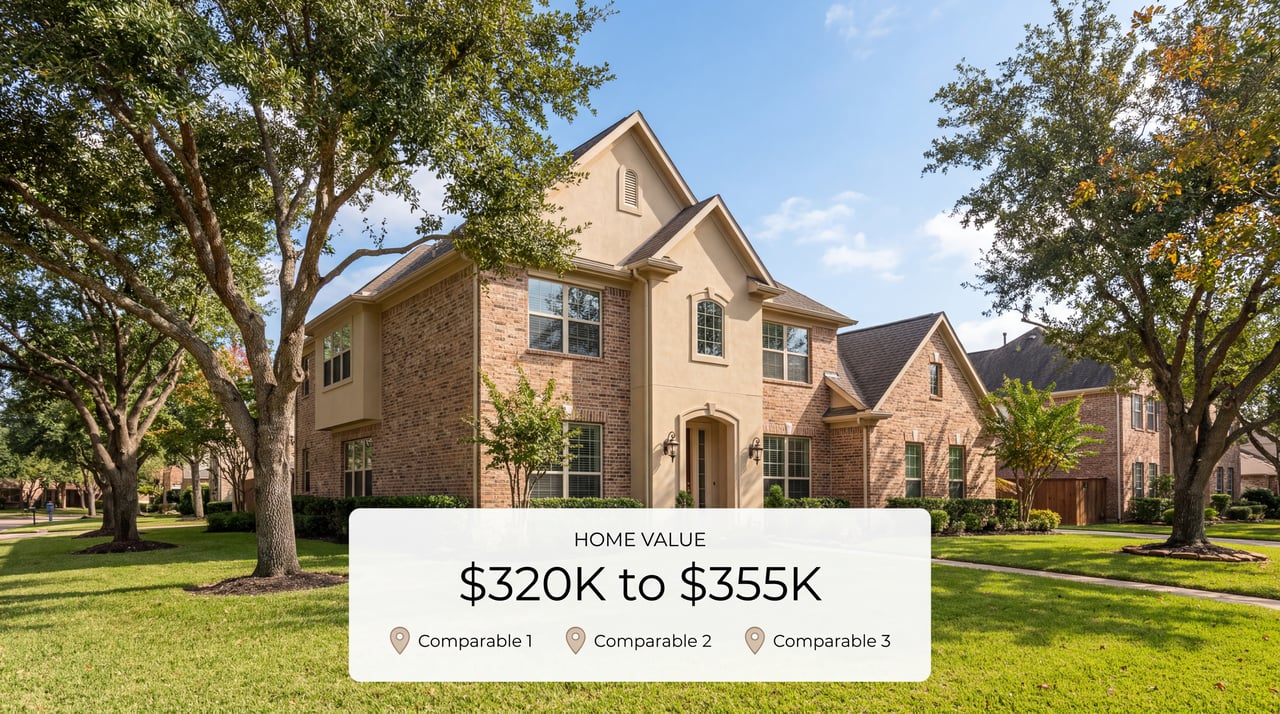
The workhorse of residential pricing is the Comparative Market Analysis. A good agent builds one in roughly six moves.
Step 1: Gather the subject property details
Square footage, bedroom and bath count, lot size, age, condition, upgrades, and location all go in first. A renovated kitchen, a new roof, or a backyard that backs to a busy road all matter here.
Step 2: Pull the right comparables
The strongest CMAs use four to six homes that sold within roughly the last three to six months, ideally within about a mile, and as similar as possible in size, age, and style. Location is the single most important filter. In Houston, "a mile away" can mean a different school zone, a different flood designation, and a different deed-restricted subdivision, so comps are chosen carefully, not just by radius.
Step 3: Add active, pending, and expired listings
Sold comps tell you where the market has been. Active listings show your current competition. Pending sales hint at where the market is heading. Expired listings reveal the prices buyers rejected, which is its own kind of data.
Step 4: Make adjustments
No two homes are identical, so the agent adjusts each comp's sale price for differences. If a comp had an extra bedroom or an updated primary bath that your home lacks, its price is adjusted down to compare fairly, and vice versa. These adjustments should come from actual local buyer behavior, not generic rules of thumb. Two skilled agents can value the same feature slightly differently, which is why local market evidence matters more than a formula.
Step 5: Weight the comps
The most similar comps carry the most weight. A near-identical house two streets over usually counts for more than a larger home a mile away that needed heavy adjustment.
Step 6: Land on a range
The result is not one number but a defensible range, plus a recommended list price that reflects your goals, your timeline, and where the market sits right now.
Where Houston's Market Sits in 2026
Context shapes value, so the number depends partly on the calendar. As of mid-2026, the Greater Houston single-family median price is hovering in the low-to-mid $330,000s, essentially flat to slightly down year over year after the sharp run-up of the pandemic years. Inventory has grown, homes are taking somewhat longer to sell (roughly 46 to 54 days on average), and the sale-to-list ratio sits near 99 percent, meaning well-priced homes still close very close to asking. Mortgage rates have settled around the mid-6 percent range.
The plain-English version: Houston has shifted toward a more balanced, slightly more buyer-friendly market. Pricing right the first time matters more now than it did in 2021, because buyers have more options and more patience. For the latest monthly figures, see the Houston Housing Market Update.
Why Online Estimates Miss
Automated estimates are a fine starting point and a terrible finish line. Here is the part most homeowners never see.
Zillow publishes its own accuracy data, and it is honest about the limits. For homes actively listed for sale, the national median error rate runs around 2 percent. For off-market homes, the kind you are checking when you are just thinking about selling, the median error rate is roughly 7 percent.
Two things make that worse than it sounds. First, "median error" means half of all estimates miss by more than that figure, not that 7 percent is the worst case. Second, the off-market estimate is the least accurate version of the number, built from the fewest data inputs. Once a home is actually listed, the estimate quietly drifts toward the list price, which is part of why the on-market figure looks so much better.
On a $335,000 Houston home, a 7 percent miss is more than $23,000 in either direction. Price off a number like that and you either leave real money on the table or sit on the market while buyers pass you by.
Home value | 7% off-market error | What that means |
|---|---|---|
$250,000 | about $17,500 | A serious mispricing on an entry-level home |
$335,000 | about $23,500 | Roughly the median Houston single-family home |
$500,000 | about $35,000 | Enough to scare off buyers or undercut your equity |
$750,000 | about $52,500 | A six-figure swing is well within range at the high end |
The reason for the gap is simple: an algorithm cannot see your home. It does not know you redid the kitchen, that the foundation was repaired and certified, that the house backs to a greenbelt, or that the comparable three doors down flooded and yours never has. As Zillow itself notes, unreported additions, updates, and remodels are not reflected in the estimate. Condition, the single biggest swing factor in any sale, is invisible to it.
The Houston Factors That Move Your Number
This is where local knowledge earns its keep. These factors barely register in a national algorithm but can move a Houston price by tens of thousands of dollars.
Factor | Why it moves value in Houston |
|---|---|
Flood history and FEMA zone | Roughly one in five Houston homes sits in a flood zone. A prior flood claim, a 100-year-floodplain designation, or a missing elevation certificate can pull value down, while a documented no-flood history is a selling point worth real money. |
Deed restrictions | With no citywide zoning, value is shaped by private deed restrictions that govern lot use, setbacks, and rebuild rights. Two similar lots can carry different values depending on what each is allowed to become. |
Micro-location | School attendance zones, proximity to bayous, lot orientation, and even which block you are on can change value sharply over a short distance. |
Condition and updates | Foundation, roof, HVAC, and kitchen and bath updates are major swing factors that no AVM can verify. |
Price per square foot | This figure is not constant. Larger homes generally sell for less per square foot than smaller ones nearby, so a flat per-foot estimate distorts the picture. More on that in Why Larger Homes Cost Less Per Square Foot. |
If your home is in or near a floodplain, it is worth understanding exactly how that affects value before you list. Start with Flood Zones in Houston: What Buyers Should Know.
CMA vs. Online Estimate vs. Appraisal
These three get used interchangeably, and they should not be. Each has a different author, cost, and purpose.
Online Estimate (AVM) | Comparative Market Analysis | Appraisal | |
|---|---|---|---|
Who creates it | An algorithm | A licensed local agent | A licensed appraiser |
Cost | Free | Usually free from your agent | Several hundred dollars, paid by the buyer |
Data used | Public records, past sales | Recent local comps, active and pending listings, condition, local knowledge | Comps plus an in-person inspection, following lender standards |
Sees your home's condition | No | Yes | Yes |
Best used for | A rough starting point | Setting your list price and strategy | Confirming value for the lender after you are under contract |
The takeaway: use the online estimate to get curious, use a CMA to set your price, and expect the appraisal later in the deal. For a deeper walkthrough, read How to Read a CMA in Houston and What Is a Home Appraisal and Why Does It Matter in Houston.
How to Get an Accurate Number
If you want a figure you can actually act on, here is the path.
First, treat any online estimate as a ballpark, not a verdict. It is useful for a gut check and nothing more.
Second, get a real CMA built around your home's actual condition and your actual block. A good one factors in your updates, your flood status, your deed-restricted subdivision, and the comps that genuinely match. This is the number you price from. If you want to see how that pricing decision gets made, How to Price Your Home in Houston breaks down the strategy.
Third, if you have time before listing, look at whether targeted improvements would lift your value more than they cost. Not every upgrade pays back. How to Increase Your Houston Home's Value Before Selling covers what actually moves the needle.
Finally, time it. In a balanced 2026 market, the right list price in the right season closes faster and for more than a high price that forces a price cut six weeks in. Overpricing is the most common and most expensive seller mistake, as covered in 5 Mistakes Houston Home Sellers Make.
Your home's worth is a real, knowable number. It is just not the one that pops up for free in three seconds. If you want an accurate, no-pressure valuation built specifically for your home and your neighborhood, a current CMA is the place to start.
Related Keywords: what is my home worth Houston, Houston home value 2026, free home valuation Houston, Houston CMA, sell my home value estimate