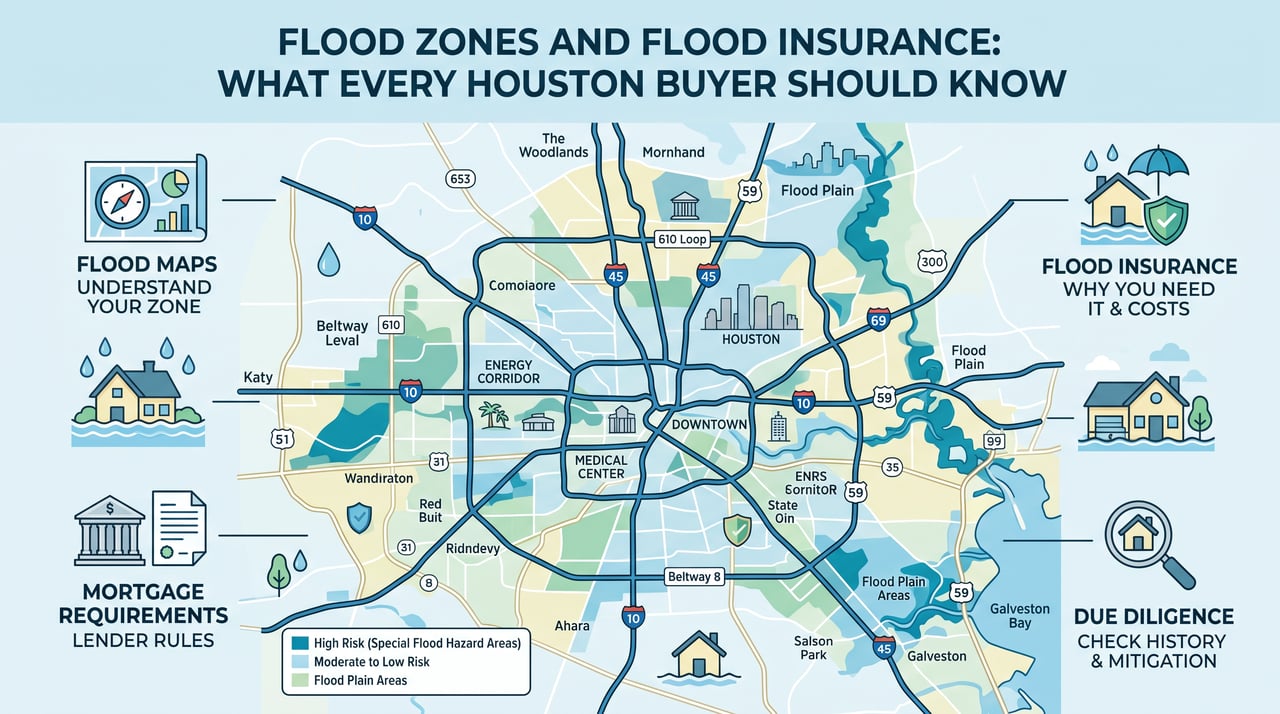
Flood Zones and Flood Insurance: What Every Houston Buyer Should Know
How to read a flood map, when insurance is required, and the questions to ask before you make an offer.
September 3, 2026 | Raquel Refuerzo
September is peak hurricane season on the Gulf Coast, and it is also the month when more Houston buyers slow down and ask the question they should have asked first: what is this home's flood risk, and what will it cost me to insure? In a city built on a flat coastal plain, that answer is rarely "zero," and it is almost never something you can read off the listing.
Two things make 2026 different. FEMA released the first complete overhaul of Harris County's flood maps in nearly two decades, and the National Flood Insurance Program is operating on a deadline that could affect closings this fall. If you are buying right now, both belong on your radar before you write an offer.
Here is how flood zones actually work in Houston, when insurance is required versus simply smart, what coverage tends to cost under the current rating system, and the specific questions that protect you during your option period.
Quick Takeaways
- Houston's flood risk extends far beyond the mapped high-risk zones. Roughly 70 percent of homes that flooded during Hurricane Harvey sat outside the official Special Flood Hazard Area.
- FEMA released new draft flood maps for Harris County in February 2026, the first countywide update since 2007. They are preliminary and do not change insurance requirements yet, but they signal where risk is being recognized.
- Flood insurance is required by your lender only when the home sits in a high-risk zone (A or V designations) and you have a federally backed mortgage. Everywhere else it is optional but often worth it.
- Under FEMA's Risk Rating 2.0, your premium is based on your specific property, not just your zone. Elevation, distance to water, foundation type, and rebuilding cost drive the price.
- The federal flood insurance program is authorized only through September 30, 2026. A lapse can stall closings that depend on it, so timing matters for fall transactions.
- Texas law requires sellers to disclose known flood history and floodplain status. Read that disclosure carefully and verify it independently.
Why Flood Risk in Houston Is Not About the Zone Alone
Houston sits on flat land where Buffalo Bayou, Brays Bayou, White Oak Bayou, and dozens of smaller channels carry stormwater toward Galveston Bay. When a slow, heavy rain event stalls overhead, those channels fill faster than they can drain, and water backs up into streets and low-lying lots that may be nowhere near a waterway on a map.
That is the single most important thing for a buyer to understand. The FEMA flood map tells you about riverine and channel flooding. It does not fully capture street ponding, drainage backups, or the kind of rainfall Houston now sees regularly. During Hurricane Harvey, the majority of flooded homes were located outside the designated high-risk zone. A home labeled "Zone X" is lower risk, not no risk.
So a flood zone is a starting point, not a verdict. The real picture comes from combining the map with the home's elevation, its flooding history, its proximity to a bayou or reservoir, and how the surrounding blocks drained in past storms.
How to Read a Houston Flood Map
FEMA divides land into zones on what is called a Flood Insurance Rate Map. In Harris County you can look up any address using the Harris County Flood Control District's viewer at hcfcd.org/MAAPnext, which now also shows the new draft data alongside the current effective maps.
Here is what the common designations mean for a buyer.
Flood Zone | Risk Level | What It Means for You |
|---|---|---|
AE, A, AO, AH | High risk (1% annual chance) | Special Flood Hazard Area. A base flood elevation usually applies. Insurance is required with a federally backed mortgage. |
VE, V | High risk, coastal | High-risk coastal areas exposed to wave action. Rare inside Houston proper, relevant near the bay. |
X (shaded) | Moderate risk | The 500-year floodplain, roughly a 0.2% annual chance. Insurance is not required but is frequently recommended. |
X (unshaded) | Minimal mapped risk | Lowest mapped risk. Insurance is optional and usually inexpensive. Remember Harvey flooded many Zone X homes. |
The 1 percent annual chance label is where the old "100-year flood" phrase comes from. It does not mean a flood happens once a century. It means there is a 1 percent chance in any given year, which over a 30-year mortgage adds up to roughly a 1-in-4 cumulative chance. That framing tends to land very differently with buyers than the "100-year" wording.
What the 2026 FEMA Map Update Means for Buyers
In February 2026, FEMA released new draft flood maps for Harris County developed through the MAAPnext program, a joint effort with the Harris County Flood Control District. It is the first complete remodel of all the county's watersheds since the maps from the mid-2000s, which were built on rainfall data collected after Tropical Storm Allison in 2001.
The new maps use updated NOAA Atlas 14 rainfall data. In practical terms, the rainfall assumed for a major storm rose by roughly 30 percent, and the modeling now accounts for how water pools and moves across flat ground rather than only tracking flow through bayous. The result is an expansion of the high-risk floodplain in many areas, though some neighborhoods actually came out of the floodplain thanks to completed detention and channel projects.
Three points matter for buyers right now.
First, these maps are draft and preliminary. They do not change anyone's insurance requirement today, and they will move through technical review and public comment before becoming effective.
Second, they are a powerful research tool. The MAAPnext viewer includes a slider that compares the current maps with the draft maps, so you can see whether a specific address is trending toward higher or lower recognized risk. That is exactly the kind of forward-looking information you want before committing to a home you plan to own for years.
Third, when these maps do take effect, properties newly mapped into a high-risk zone will face an insurance requirement they did not have before. Buying with that knowledge lets you price it in rather than be surprised by it later.
When Flood Insurance Is Required Versus Optional
Standard homeowners insurance does not cover flooding. That surprises many first-time buyers, so it is worth stating plainly: a flood policy is a separate purchase.
Whether you are required to carry it comes down to two questions. Is the home in a high-risk zone, and do you have a federally backed or federally regulated mortgage? If both are true, your lender will require flood insurance for the life of the loan. If the home is in a moderate or minimal-risk zone, coverage is optional, and the decision is yours.
My standing advice for Houston buyers is simple. If a home is anywhere near a bayou, a reservoir, or a low-lying intersection, price out a policy even when it is not required. Optional coverage in a lower-risk zone is often a few hundred dollars a year, which is modest insurance against a five- or six-figure loss. The buyers who regret skipping it are almost never the ones who paid for it.
What Flood Insurance Actually Costs in Houston
Flood insurance through the National Flood Insurance Program no longer uses a flat rate by zone. Under the current pricing system, called Risk Rating 2.0, FEMA prices each property on its own characteristics. The zone still decides whether coverage is mandatory, but it is no longer what sets your premium.
The factors that move your price include your elevation relative to expected flood levels, your distance to the nearest water source, your foundation type, and the cost to rebuild your specific home. This is why two houses on the same street, even in the same zone, can carry very different premiums.
In recent Houston-area datasets, typical NFIP premiums have landed in a broad range, with many policies falling somewhere between roughly $770 and $1,600 a year and a median near the middle of that band. High-risk zone properties commonly run several hundred to more than a thousand dollars higher than moderate-risk homes. Coastal and lower-elevation homes sit at the top of the range. Private flood insurers also compete in this market and sometimes beat the NFIP quote, so it pays to shop both.
Premium Driver | Lower Premium | Higher Premium |
|---|---|---|
Elevation vs. expected flood level | Home sits well above | Home sits at or below |
Distance to water | Far from bayou or coast | Adjacent to channel or bay |
Foundation type | Slab on higher ground | Crawlspace or lower entry |
Rebuilding cost | More modest replacement cost | High-value, costly to rebuild |
Mitigation features | Flood vents, elevation certificate | None |
Two practical money-savers worth knowing. An elevation certificate can sometimes prove your home sits higher than FEMA's data assumes, which may lower your rate. And if the current owner already has an NFIP policy, that policy can often be assigned to you at closing, letting you keep their existing rate rather than starting fresh. Always ask the listing agent whether a transferable policy exists. Factoring insurance into your monthly number is part of figuring out how much house you can actually afford in Houston, and it belongs in the same conversation as closing costs and the other expenses buyers underestimate.
The September 30 Deadline Every Fall Buyer Should Watch
The National Flood Insurance Program is currently authorized only through September 30, 2026. The program has run on a long series of short-term extensions, and it has lapsed several times, including a 43-day lapse in late 2025 and a brief lapse in early 2026.
This matters because of timing. When the program lapses, it cannot issue new policies or renewals. Existing policies stay in force, and claims continue to be paid while funds are available, but a buyer who needs a new policy to close on a high-risk home can find the transaction stalled. Industry estimates suggest a nationwide lapse can affect more than a thousand sales a day.
If you are buying a home this fall that requires flood insurance, build this into your plan. Two protections help. Ask whether the seller's existing NFIP policy can be assigned to you, since assignment keeps coverage in place even during a new-policy freeze. And know that private flood insurance is not tied to the federal program, so a private policy is unaffected by a lapse and can be an alternative path to closing. Your lender ultimately decides what it will accept, so confirm early.
Texas Requires Sellers to Disclose Flood History
Texas strengthened its flood disclosure law after Harvey. Since September 1, 2019, the Seller's Disclosure Notice required under Section 5.008 of the Texas Property Code asks sellers to disclose, to the best of their knowledge, whether the property is in a 100-year or 500-year floodplain, whether it sits in a reservoir or flood pool, whether it has flooded, whether they have filed a flood insurance claim, and whether they have received federal flood assistance.
Read that section of the disclosure closely. A "yes" to prior flooding or a prior claim is not automatically a deal-breaker, but it is a signal to dig deeper into what was damaged, what was repaired, and how the home performed afterward. Note one important gap: new construction is generally exempt from the seller's disclosure requirement, so on a brand-new home you will need to do your own flood research rather than rely on a prior owner's history.
The reservoir question carries special weight in west Houston. Homes near the Addicks and Barker reservoirs experienced flooding from controlled releases during Harvey, both upstream and downstream, and that history is exactly what the reservoir and flood-pool disclosures are meant to surface.
If a seller delivers the disclosure after you have already signed, Texas law gives you a window to terminate. That is one of several reasons your contract's contingencies and option period matter so much, and why verifying flood facts is a core part of your home inspection and due diligence.
Questions to Ask Before You Make an Offer
Use your showings and your option period to get clear answers. Before you commit, you want to know:
- What flood zone is this address in, on both the current map and the new MAAPnext draft map?
- Has this home ever flooded, and if so, when, how deep, and what was repaired?
- Is there an existing flood insurance policy, and can it be assigned to me at its current rate?
- What would a new policy cost, from both the NFIP and a private insurer?
- How does this street and block drain during heavy rain, and is the lot higher or lower than its neighbors?
- Is the home near a bayou, a detention basin, or a reservoir flood pool?
- For new construction, what is the builder's pad elevation and the drainage plan for the section?
A buyer's agent who knows Houston's flood geography can pull the zone data, request the policy details, and read the disclosure with a trained eye, which is a meaningful part of what good buyer representation provides. If you are relocating from out of state and unfamiliar with the bayou system, this is one area where local guidance pays for itself many times over, and it is covered in more depth in our Houston relocation guide.
The Bottom Line
Flood risk in Houston is manageable when you measure it honestly. The map is your first read, not your final answer. Verify the zone on both the current and draft FEMA maps, study the home's elevation and drainage, take the seller's disclosure seriously, and price insurance into your budget before you fall in love with a house. Watch the September 30 reauthorization deadline if your closing depends on a federal policy, and ask whether an existing policy can come with the home.
Do that work up front, and a flood zone stops being a source of fear and becomes just another factor you priced in with clear eyes. If you want help running flood data on a specific address or estimating what coverage will cost, reach out to Raquel at 832-415-9228 or realtyraquel.com.
Related Keywords: Houston flood zones, flood insurance Houston, buying a home in a flood zone Texas, FEMA flood map Houston, flood risk Houston neighborhoods