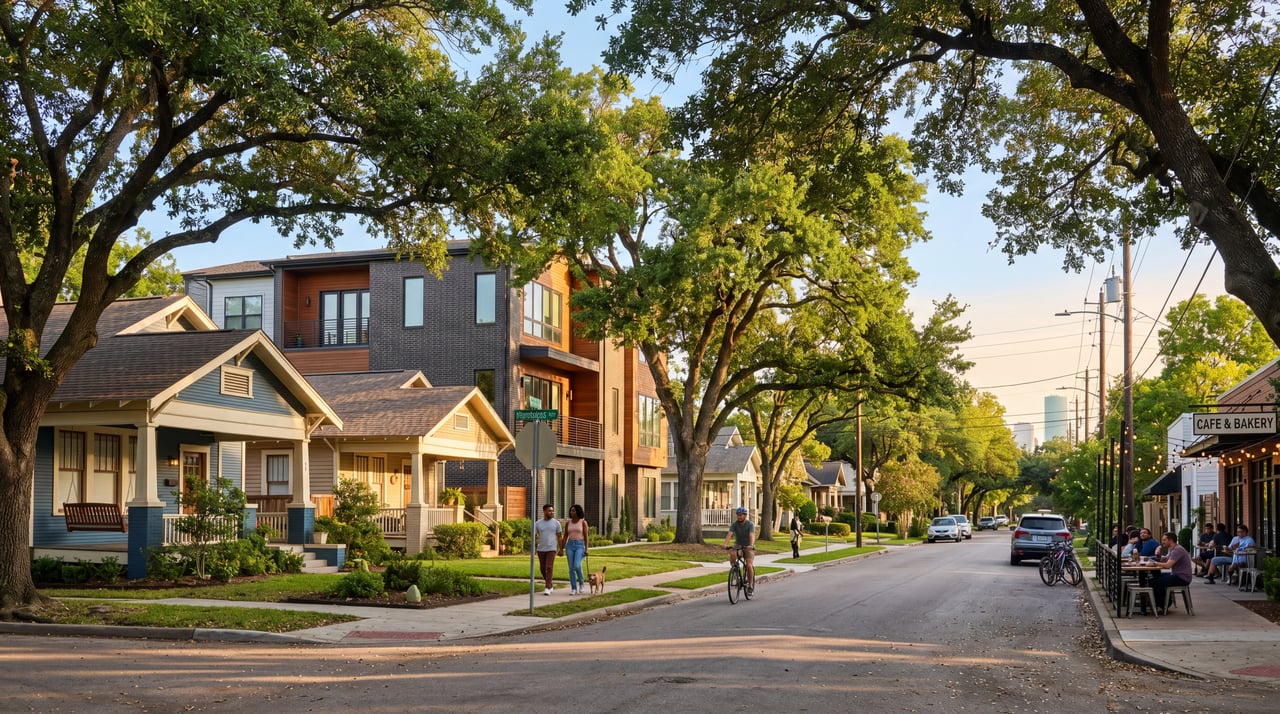
Houston's Most Welcoming Neighborhoods: A Guide to Montrose, Midtown, and the Heights
Community, walkability, and home options in the city's most inclusive, vibrant pockets.
September 15, 2026 | Raquel Refuerzo
Houston is a city of neighborhoods, not a single downtown core, and the personality of where you live shapes daily life more than almost any other decision you make as a buyer. For people who want to walk to dinner, know their neighbors, and feel genuinely at home regardless of who they are, three Inner Loop neighborhoods consistently rise to the top: Montrose, Midtown, and the Heights.
These pockets share a common thread. They are dense, walkable, and built around community in a way that most of sprawling Houston is not. But they are far from interchangeable. The right fit depends on your budget, your stage of life, and what you want your front door to open onto. Here is an honest, data-forward look at all three.
Quick Takeaways
- Montrose is Houston's historic cultural and LGBTQ+ heart, the most expensive of the three, and the most architecturally diverse. Single-family medians run high, but townhomes and condos open the door at lower price points.
- Midtown is the most affordable and the most transit-connected, anchored by the METRORail Red Line and a dense social scene. It skews toward condos, townhomes, and mid-rise living.
- The Heights delivers historic bungalows, the strongest long-term appreciation of any Inner Loop neighborhood, and a tight, fast-moving market.
- All three carry Walk Scores in the mid-80s or higher, putting car-optional living within reach.
- Prices have softened across Houston in 2026, which means more negotiating room than buyers have had in years.
A note on the 2026 market
Before we go neighborhood by neighborhood, the backdrop matters. Houston's median sale price sat around $340,000 to $345,000 in early 2026, down roughly 2 to 3 percent year over year, with homes taking longer to sell than they did a year earlier. That cooling is your leverage. In these three neighborhoods especially, longer days on market and more frequent price reductions mean a prepared buyer has real room to negotiate.
Montrose: Culture, Character, and Community
If you want to understand why Montrose feels different the moment you arrive, start with its history. Montrose has been the center of Houston's LGBTQ+ life since the 1970s, with galleries, bars, and community organizations that anchored the neighborhood through the AIDS crisis and every decade since. Houston held its first Pride celebration in 1978, and the Montrose Center, founded that same year as a volunteer clinic, has grown into a full LGBTQ+ community organization offering health services, youth programs, and senior support.
Today the neighborhood remains the cultural and social hub for the community, with the city's highest concentration of LGBTQ+ bars, restaurants, and gathering spaces along the Pacific Street, Fairview Street, and Westheimer corridors. But Montrose has never been a single-note neighborhood. It is genuinely mixed, drawing artists, creative professionals, medical workers, and families who want character and convenience in equal measure.
What you get for your money in Montrose
Montrose occupies a prime, central position just west of downtown, roughly bordered by Allen Parkway, Shepherd Drive, Bagby Street, and US-59. With about 34,000 residents and a median age of 37, it is dense, educated, and walkable, carrying a Walk Score of 86 and a Bike Score of 73 that make daily errands on foot or by bike genuinely practical.
The housing stock is the widest of the three neighborhoods: early 20th-century bungalows, restored mansions, Art Deco apartment buildings, and sleek new townhomes often sit on the same block. That range is reflected in pricing. Single-family homes carry a median around $762,000 with an average of roughly 92 days on market, while townhomes have run a median near $719,500. New luxury construction regularly clears $900,000 and approaches $1.3 million for premium spec builds, giving Montrose the highest price ceiling of the three. Over the past decade, values have appreciated about 30 percent.
Who Montrose fits
This is the neighborhood for buyers who prioritize culture, walkability, and a recognized Houston address, and who value being within walking or biking distance of the Museum District, the Menil Collection, and a deep bench of independent restaurants. The trade-off is cost. Lot availability is limited and some blocks carry city overlay restrictions, so new construction supply is tighter and entry single-family prices are higher than in most of Houston. For a deeper look, see my Neighborhood Overview: Montrose.
Midtown: Urban, Connected, and Affordable
Midtown sits directly south of downtown and trades architectural variety for energy and access. This is Houston's most transit-friendly Inner Loop neighborhood, connected to downtown and the Texas Medical Center by the METRORail Red Line, which makes a car genuinely optional for many residents. The social scene is constant, with bars, brunch spots, parks, and grocery stores packed into a compact footprint.
What you get for your money in Midtown
Midtown is the most walkable of the three on paper, with a Walk Score in the upper 80s to 90, and it is the most budget-friendly. The median sale price across home types has hovered around $320,000, though that number reflects a market that has softened more sharply here than in Montrose or the Heights, with longer days on market in recent data. For buyers, that softness is an opening.
The housing mix leans heavily toward condos, townhomes, and mid-rise buildings rather than single-family homes, so this is a neighborhood where understanding HOA structures and condo financing matters. If a townhome or condo is on your list, my Houston Townhome Buying Guide walks through the considerations that single-family buyers often miss.
Who Midtown fits
Midtown is built for young professionals, Medical Center employees, and anyone who wants urban living with a short commute and a lively community at street level. The trade-offs are real: noise near the Milam Street bar district, fewer single-family options, and a market that has been more volatile. But for a first Inner Loop purchase or a transit-first lifestyle, the value is hard to beat. See my full Neighborhood Overview: Midtown, and if you are early in your career, the best Houston neighborhoods for young professionals is worth a read.
The Heights: Historic Bungalows and Staying Power
The Heights sits two to four miles northwest of downtown and offers something the other two neighborhoods cannot quite match: a preserved, historic streetscape that most Houston suburbs spend decades trying to manufacture. The 19th Street retail corridor, the White Oak Bayou trail system, and a dense roster of local restaurants and coffee shops give the neighborhood a genuine, walkable identity.
What you get for your money in the Heights
This is bungalow country. The Heights is the center of Houston's turn-of-the-century restoration culture, and buyers here often work with architects on period homes rather than building new. That character commands a premium. The median home price has run around $675,000 to $690,000, with 2025 data showing homes moving in roughly 9 days at about $332 per square foot. New luxury townhomes typically run $650,000 to $950,000, often built in small groups on former bungalow lots.
What sets the Heights apart financially is staying power. Over the past decade it has appreciated about 49 percent, the highest 10-year rate of any Inner Loop neighborhood. Fast sales at these prices are not a sign of a soft market; they reflect persistent demand against limited supply.
Who the Heights fits
The Heights suits buyers who want historic character, a strong neighborhood identity, and the most reliable long-term appreciation of the three. Families and young professionals both land here. The trade-off is competition and speed. Well-priced homes move quickly, so pre-approval and a sharp strategy matter more here than almost anywhere else in the Loop. Start with my Neighborhood Overview: The Heights.
Side-by-Side: Montrose vs. Midtown vs. The Heights
Factor | Montrose | Midtown | The Heights |
|---|---|---|---|
Median price (range) | ~$762K single-family; ~$720K townhome | ~$320K across home types | ~$675K to $690K |
Walk Score | 86 | Upper 80s to 90 | High, walkable corridors |
Dominant housing | Bungalows, townhomes, mansions, condos | Condos, townhomes, mid-rises | Historic bungalows, new townhomes |
10-year appreciation | ~30% | More volatile | ~49% (highest in the Loop) |
Best known for | Arts, culture, LGBTQ+ community | Transit, nightlife, affordability | Historic charm, appreciation |
Transit | Walkable, central | METRORail Red Line | Bayou trails, near downtown |
Best fit | Culture-first, wider luxury ceiling | First Inner Loop buy, transit lifestyle | Character and long-term value |
Pricing reflects HAR MLS-derived data from early 2026 and shifts month to month. Treat these as directional, not exact.
How to Choose Between Them
The honest answer is that all three are excellent, and the deciding factor is rarely the neighborhood itself. It is your budget, your commute, and the home type you actually want.
If your budget tops out near Houston's median and you want walkability with a short commute, Midtown likely makes the most sense, especially if a condo or townhome fits your life. If you want historic character and you are buying for the long haul, the Heights has rewarded patience better than anywhere else in the Loop. And if community, culture, and a central, car-optional lifestyle are what you are after, Montrose is worth stretching for.
Two practical notes for any Inner Loop purchase. First, flood history matters in central Houston, and it varies block by block, so review it carefully before you fall in love with a home. My guide to Houston flood zones covers what to check. Second, commute realities shape satisfaction more than buyers expect; the Houston commute guide helps you pressure-test the daily drive before you commit.
If you are weighing a move to one of these neighborhoods, the right strategy looks different in each, and the softer 2026 market gives prepared buyers leverage that did not exist a year ago. I have helped buyers land in all three, and I am happy to talk through which one fits your life and your numbers. You can reach me anytime at 832-415-9228.
For more on where community and housing opportunity meet across the city, see What Are the Most LGBTQ+ Friendly Neighborhoods in Houston? and my neighborhood-by-neighborhood look at the best restaurants in Houston.
Related Keywords: Montrose Houston real estate, LGBTQ friendly neighborhoods Houston, living in Montrose, Midtown Houston homes, best Houston neighborhoods community