What Is a CMA? How Houston Real Estate Agents Determine Your Home's Price
The comparative market analysis explained in plain English — and why it matters
Published: June 30, 2026 | By Raquel Refuerzo
If you've ever asked a Houston agent "what's my home worth?" and they said "let me run some comps," they were talking about a CMA. The comparative market analysis is one of the most important tools in real estate, and yet most buyers and sellers have never actually seen one explained. This post breaks it down in plain English so you know exactly what goes into pricing a home in Houston, and what to do with that information.
Quick Takeaways
- A CMA estimates your home's value by comparing it to similar homes that sold recently in your area.
- It is not the same as a formal appraisal, but it is the primary tool agents use to set a listing price or write a competitive offer.
- In Houston's current market, with homes averaging 69 days on the market, accurate pricing from day one is critical.
- A CMA is typically free when you work with a local agent.
- Online estimates like Zestimates are useful starting points, but they miss the neighborhood-level nuance that makes or breaks pricing in Houston.
What Is a CMA in Real Estate, and Why Does It Matter in Houston?
A comparative market analysis, or CMA, is a pricing tool used by licensed real estate professionals to estimate what a home is worth right now, based on what similar homes have actually sold for in the same area. It draws on data from the MLS, which gives agents access to real transaction numbers that you won't find anywhere else.
Here's why this matters in Houston specifically. The local market is hyper-local. What happened in The Heights two months ago has almost nothing to do with what's happening in Spring Branch today. A good CMA accounts for that. It narrows the lens to your specific neighborhood, your property type, and your price range so the numbers actually reflect what buyers are paying in your zip code.
A CMA is also where a pricing strategy starts, whether you're a seller trying to maximize your sale price or a buyer trying to write a competitive offer without overpaying. According to data from HAR.com, the median sale price in Houston as of February 2026 was $322,078, with homes averaging 69 days on the market. That's the highest average days on market since 2013. In a market where buyers have time to be selective, pricing precision is not optional.
How Does a Comparative Market Analysis Actually Work?
When an agent runs a CMA, they're doing a side-by-side comparison of your home against recently sold properties with similar characteristics. Here's how that process unfolds.
Step 1: Identify the Subject Property
The agent starts with your home. They note everything: square footage, number of bedrooms and bathrooms, lot size, year built, condition, upgrades, school district, and location within the neighborhood. All of this becomes the benchmark for what gets compared.
Step 2: Pull Comparable Sales ("Comps")
The agent then searches the MLS for homes that sold nearby, ideally within the past three to six months, that are similar in size, style, and location. A solid CMA typically uses three to five comps. The closer the comparison, the more accurate the analysis. The goal is to compare apples to apples, not a renovated 2,200-square-foot bungalow to a dated 1,800-square-foot townhome.
Step 3: Adjust for Differences
No two homes are identical. If a comp has an extra bathroom or a bigger lot, the agent adjusts the price to account for that difference. These adjustments require real market knowledge because the dollar value of a swimming pool in Memorial Villages is not the same as in another neighborhood.
Step 4: Factor in Market Conditions
A CMA also accounts for whether the market is trending up, flat, or cooling. In Houston right now, Redfin data shows the average home sells for about 4% below list price, with 34% of listings taking a price reduction before selling. That context shapes how aggressively you price from the start.
Step 5: Deliver a Price Range
The result is not one magic number. A well-prepared CMA gives you a price range, typically with a low, a midpoint, and a high. Where you land within that range depends on your goals, your timeline, and your appetite for negotiation.
How Is a CMA Different From a Home Appraisal?
This is one of the most common questions sellers ask. The short answer: a CMA is what happens before a contract. An appraisal is what happens after.
A CMA is prepared by a licensed real estate agent as part of the listing or offer process. It is informal, free, and based on the agent's expertise and MLS data. Its job is to help you and your agent settle on a smart list price or a competitive offer price.
A home appraisal is a formal valuation conducted by a licensed appraiser, usually ordered by the buyer's lender after a contract is signed. The lender requires it to confirm the home is worth what the buyer agreed to pay before approving the loan. Appraisers use many of the same comparable sales an agent would use in a CMA, which is why a well-priced home tends to pass appraisal without surprises.
Here's the practical takeaway. If you price your home well using a strong CMA, your buyer's appraisal is much less likely to come in low and threaten the deal. If you overprice and eventually reduce, you've already lost the window when buyer interest is highest.
| Factor | CMA | Appraisal |
|---|---|---|
| Who prepares it | Licensed real estate agent | Licensed appraiser |
| When it happens | Before a contract | After a contract is signed |
| Purpose | Set list price or offer strategy | Confirm value for lender |
| Cost | Free (with agent) | $400–$700 typically |
| Legally binding | No | Yes, for lending purposes |
What Does a CMA Look Like in Practice? A Houston Example
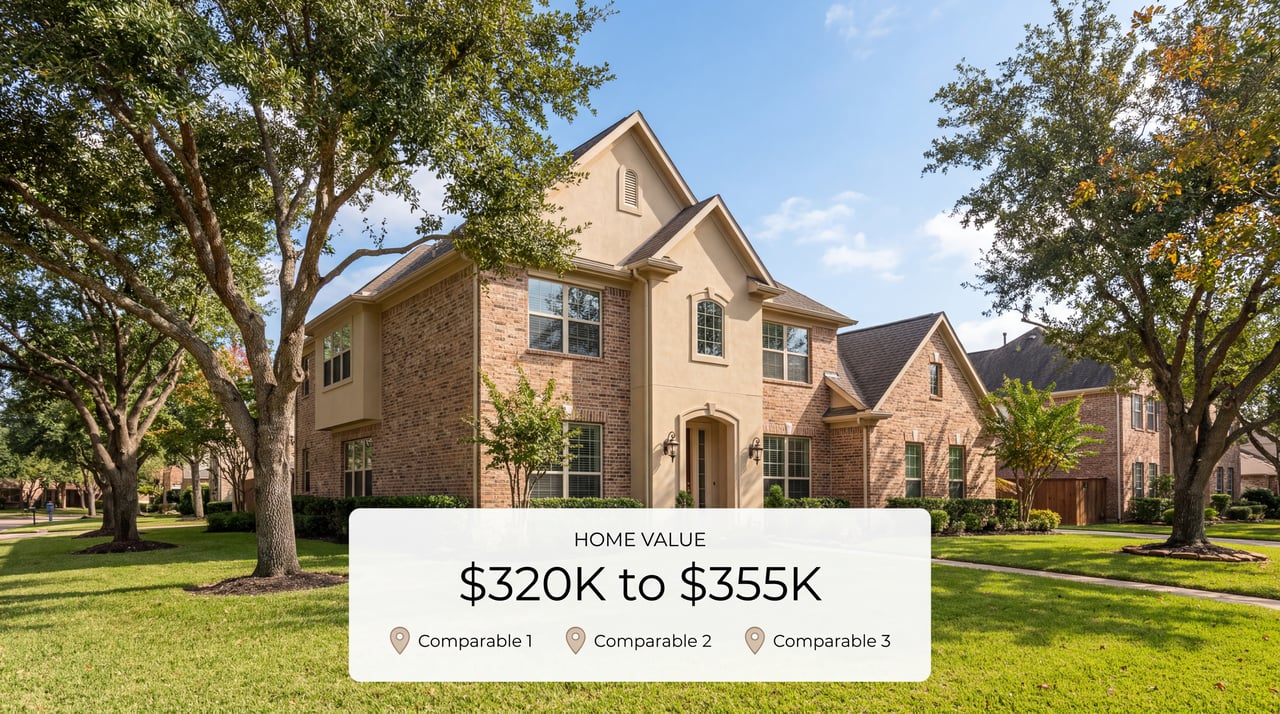
Say you own a three-bedroom, two-bath home in Midtown at roughly 1,600 square feet. Your agent pulls three comps from the past 90 days in your immediate area. One sold at $380,000, one at $395,000, and one at $410,000. The agent notes that the highest-priced comp had a recently updated kitchen you don't have, so they adjust that down slightly. The lowest-priced comp sold quickly in a cash deal, which means it probably underpriced the market.
After adjustments, the analysis points to a realistic market value in the $390,000 to $405,000 range. Your agent recommends listing at $399,000 to attract buyers, generate showing activity quickly, and position for negotiation if needed.
That's the CMA doing its job. It removes guesswork from a decision that could cost you tens of thousands of dollars if you get it wrong.
Why Online Estimates Fall Short in Houston
Zillow's Zestimate, Redfin's estimate, and similar tools are convenient. But they work off public records and algorithms, not the street-level knowledge an agent brings. In Houston, that gap is significant.
Houston has no zoning laws. A single block in Montrose or EaDo can mix single-family homes, townhomes, and commercial properties side by side. Automated tools don't always know which end of a street is desirable, whether a nearby development will affect value, or how a recent flood event shifted buyer sentiment in a particular subdivision. Agents do.
Research consistently shows that online home value estimates for Houston fall within five to ten percent of actual sale prices for standard properties. That sounds close until you realize that a 5% miss on a $350,000 home is $17,500. A skilled agent's CMA, built on MLS data and genuine local knowledge, gets you much closer to the number that buyers will actually pay.
How to Use a CMA Whether You're Buying or Selling
The CMA is not just for sellers. Here's how to use it on both sides of a transaction.
If You're Selling
Request a CMA from your agent before setting a list price. Use it to pressure-test any number you had in mind. If the comps don't support your target price, that's information worth having before you list, not after your home has been sitting for 60 days. Overpriced homes in Houston's current market aren't just sitting longer. According to local data, homes overpriced by 10% or more can spend 30 to 60 days more on the market than correctly priced ones, and sellers often end up accepting a lower final price anyway.
For more on what goes into pricing your home strategically from the start, the how to price your home in Houston guide walks through the full picture.
If You're Buying
Ask your agent to run a CMA on any home you're seriously considering before you write an offer. It tells you whether the asking price is reasonable, and it gives you data to back up a negotiation if the home is overpriced. In Houston right now, average homes are selling for about 4% below list price. Knowing the comps gives you leverage.
For buyers still working through the full process, the closing costs guide for Houston buyers is a useful companion read.
Getting Your CMA: What to Expect
A CMA is something most experienced Houston agents provide free and without obligation. When I work with a seller, the CMA is the first serious conversation we have, because without knowing where the market actually is, every other decision is a guess.
What makes a CMA strong isn't just the data. It's the interpretation. Two agents working from the same comps can arrive at different price recommendations depending on their depth of local knowledge, how carefully they adjust for differences, and how well they understand current buyer behavior in your specific area.
If you want to know what your Houston home is worth right now, the home valuation tool at realtyraquel.com is a good starting point. And when you're ready for a full CMA backed by real MLS data, reach out directly. Pricing a home correctly from the start is one of the most valuable things a great agent does.
A CMA takes the emotion out of pricing and replaces it with evidence. In a market where buyers are informed, inventory is rising, and homes are sitting longer than they have in over a decade, that evidence is exactly what you need to make the right move.
What questions do you have about how Houston homes get priced? Drop them in the comments or send a message directly.
Related Keywords: what is a CMA real estate Houston, comparative market analysis Houston, how agents price homes Houston, how to price your home Houston TX, home valuation Houston, real estate comps Houston, CMA vs appraisal Houston, Houston home pricing strategy, what are comps in real estate, how to value a home Houston, Houston MLS home values, selling a home in Houston, home listing price Houston, Houston housing market 2026, home valuation tools Houston, how much is my home worth Houston, Houston real estate agent pricing, days on market Houston homes, overpriced home Houston, CMA report real estate Texas, Houston home seller tips, buyer offer strategy Houston, HAR home values Houston, real estate market analysis Houston, Houston home price per square foot