NO ZONING IN HOUSTON: WHAT IT REALLY MEANS WHEN YOU BUY INSIDE THE LOOP
Out-of-state buyers, read this before you fall in love with a house
Published: April 8, 2026 | By Raquel Refuerzo
You found a house inside the 610 Loop. The block looks quiet. The neighbors seem great. The price makes sense. You're ready to make an offer.
Then someone mentions Houston has no zoning laws, and suddenly you have more questions than answers.
If you're relocating from another state, this part of Houston real estate stops a lot of buyers in their tracks. Most cities use zoning to control what gets built next to what. Houston does not. The city has voted down zoning three separate times, most recently in 1993. So before you fall in love with a property, you need to understand what that means for you, your investment, and your neighbors.
Here's what Houston's no-zoning reality actually looks like for buyers shopping inside the loop.
What Does "No Zoning" Actually Mean in Houston?
Houston is the largest city in the United States without traditional zoning laws. In most American cities, the local government divides land into districts and assigns permitted uses: residential here, commercial there, industrial over there. Houston does not do that. The city uses ordinance codes to regulate how land gets subdivided, but there are no city-wide rules dictating whether a given parcel becomes a home, a restaurant, or a warehouse.
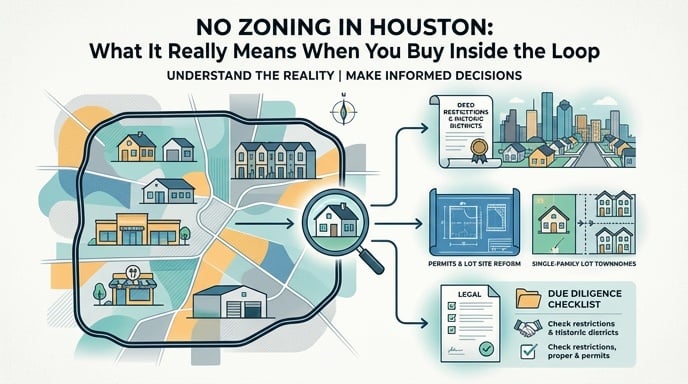
What this means in practice: a townhome development, a commercial strip, or a multi-family complex can legally go up next to a single-family home on the same block, as long as the lot meets subdivision and building code requirements.
For out-of-state buyers, this is the single most disorienting part of buying in Houston. You're accustomed to a city where residential neighborhoods stay residential because the government says so. In Houston, something else does that work.
So What Actually Protects Houston Neighborhoods?
Deed Restrictions: The Substitute for Zoning
The primary tool that keeps many Houston neighborhoods residential is the deed restriction. A deed restriction is a legally binding agreement recorded against a property that limits how the land gets used. Restrictions can cover permitted uses, building setbacks, minimum lot sizes, height limits, and more.
What makes Houston unique is that the city actively enforces deed restrictions on behalf of residents. In most other cities, deed restrictions are purely private and enforced through HOA fees or civil suits. In Houston, the city's Legal Department has a Deed Restriction Enforcement Team that residents can call to report violations.
The Catch: Not Every Property Has Them
According to research from multiple urban policy experts, only about 25 percent of Houston's land is covered by deed restrictions. That means large portions of the city have no private protections against mixed-use development. Inside the loop, coverage varies street by street, subdivision by subdivision.
Some older inner-loop neighborhoods have deed restrictions but no active HOA. Enforcement in those cases depends on neighbors filing complaints or taking civil action themselves. Other areas have both deed restrictions and a well-funded civic club. And some blocks have neither.
What Happens Where There Are No Deed Restrictions?
Without deed restrictions, a property owner on your block can build a small commercial operation, subdivide a lot for townhomes, or convert a house to a business. This is not theoretical. You'll find it happening in several inner-loop areas right now.
What Should Out-of-State Buyers Do Before Making an Offer?
Pull the Deed Restrictions for the Specific Lot
This is not optional. Your title company can pull recorded deed restrictions through the Harris County Clerk's office. Ask specifically for restrictions on the subject property and nearby parcels. Review them before your option period ends.
Pay attention to expiration dates. Most Houston deed restrictions run 25 to 30 years and must be renewed by a majority of property owners. If a neighborhood's restrictions have expired and not been renewed, the protections you assumed were in place may no longer exist.
Check What's Happening on Adjacent Lots
Look at the vacant lots, the fresh demo sites, and the recent permit activity around any home you're considering. Under Houston's 2001 lot-size reform, minimum lot sizes inside the 610 Loop were reduced, opening up dense townhome construction across large stretches of the inner city. A single-family lot next door can legally become two or three townhomes if deed restrictions don't prevent it.
You want to buy in a block with active restrictions, not a block that used to have them.
Understand Historic Districts as a Stronger Layer of Protection
Some inner-loop neighborhoods have pursued historic district designation as a more durable substitute for zoning. Historic districts in Houston require that new construction match the scale and character of the surrounding area. The Heights, for example, has multiple historic districts created specifically to manage the surge of apartment development that followed gentrification.
If long-term neighborhood stability matters to you, a historic district-covered block adds a meaningful layer of protection that deed restrictions alone don't always guarantee.
Does No Zoning Make Houston Riskier to Buy In?
People think Houston's lack of zoning means chaos. The reality is more nuanced.
Many inner-loop neighborhoods are stable, deed-restricted, and have maintained their residential character for decades. River Oaks and Tanglewood, for example, enforce tight deed restrictions that produce neighborhoods that look and feel indistinguishable from zoned cities. Bellaire and West University, two small independent cities inside the loop with formal zoning, sit surrounded by Houston and aren't dramatically different in character from well-restricted Houston neighborhoods nearby.
At the same time, some inner-loop blocks are actively transitioning. You can be on a quiet street today and watch a townhome development go up across the alley next year, all legally, if the lot isn't restricted.
The risk isn't uniformly high. The risk is uneven, and it's your job, with your agent's help, to know exactly which type of block you're buying on before you close.
Which Inner Loop Neighborhoods Tend to Have Stronger Protections?
Neighborhoods with Active Civic Clubs and Deed Restrictions
Midtown, Montrose, Rice Military and the Washington Corridor, and Greater Heights each have active neighborhood associations and varying levels of deed restriction coverage. The Heights specifically benefits from historic district overlays that limit density and development character in designated sections.
EaDo and other transitional inner-loop areas are seeing significant development activity. That can mean appreciation opportunity, but it also means the neighborhood character around a specific block may shift faster than you expect.
What to Ask Your Agent Before You Tour
Before you schedule tours, ask your agent to tell you: Does this block have recorded deed restrictions? When do they expire? Is there an active civic club or HOA enforcing them? Are there any recent permits pulled on adjacent lots?
If your agent doesn't know the answers off the top of their head, they should be able to find them quickly. These aren't obscure questions. They're the basic due diligence that protects you in a city without zoning.
What Are the Real Advantages of Buying in a No-Zoning City?
For all the complexity, Houston's no-zoning framework has real benefits for buyers.
Development moves faster here. Builders don't spend years in approval processes fighting neighborhood opposition. Houston saw more housing built inside its inner loop alone than entire comparable cities like Atlanta or San Diego over a measured period, because the regulatory burden is lower. That supply helps keep home prices relatively affordable compared to other large metros.
You also get a wider variety of housing types at different price points in close proximity. Townhomes, bungalows, condos, and traditional single-family homes often sit within a few blocks of each other inside the loop. For buyers who want to stay in a specific neighborhood but need flexibility on price, that mix is genuinely useful.
The key is knowing which blocks and which protections work for your goals. Houston rewards buyers who do their homework.
Your Due Diligence Checklist Before Buying Inside the Loop
Before you make an offer on any inner-loop property, go through this list with your agent:
Request recorded deed restrictions from the Harris County Clerk or your title company. Review expiration dates and renewal history. Check permit activity on adjacent lots via the City of Houston Permitting Center. Confirm whether the block falls within a historic district. Ask about active civic associations and their enforcement track record. Check the flood zone designation using FEMA maps and the Harris County Flood Control District. Talk to neighbors about recent changes on the block.
Your agent should walk you through all of this before your option period ends. If they're not doing that in Houston, you need a different agent.
The truth is, buying inside the Houston loop is not more dangerous than buying in a zoned city. It's different. The protections are real, but they're private and uneven, not citywide and automatic. The city you're moving to rewards buyers who ask the right questions.
Ready to buy inside the loop with someone who knows which blocks have real protections? Reach out to Raquel Refuerzo. She's helped buyers from across the country find the right home in the right Houston neighborhood, and she'll make sure you know exactly what you're buying before you fall in love with it.
What questions do you have about buying inside the loop? Drop them below or reach out directly at (832) 415-9228.
Related Keywords: Houston no zoning laws real estate, Houston deed restrictions inner loop, buying home Houston no zoning, Houston inner loop real estate, Houston zoning laws explained, no zoning Houston buyers guide, deed restrictions Houston neighborhoods, Houston real estate out of state buyers, relocating to Houston home buying, inner loop Houston homes for sale, Houston Heights deed restrictions, Montrose Houston real estate, EaDo Houston homes, Houston real estate agent inner loop, buying a home in Houston TX, Houston townhome development inner loop, Houston 610 loop real estate, Houston no zoning neighborhoods, Harris County deed restrictions, Houston historic districts real estate