Best Neighborhoods in Houston for Out-of-State Buyers: A 2026 Match Guide by Lifestyle
From inner loop walkability to master-planned suburb living. How to find your fit before you fly in.
Published: April 20, 2026 | By Raquel Refuerzo
You're relocating to Houston. You've got a job offer, a moving date, and a budget. What you don't have yet is a neighborhood. And here's the thing: Houston is massive. Over 640 square miles massive. Picking the wrong area doesn't just mean a longer drive. It can mean a completely different lifestyle, school district, price point, and daily experience. This guide breaks down the best neighborhoods in Houston for out-of-state buyers by lifestyle match, so you can narrow your search before you ever board a plane.
Quick Takeaways:
- Houston neighborhoods fall into three broad lifestyle zones: inner loop urban, mid-ring transitional, and master-planned suburban
- Your work commute corridor is the most important filter to apply first
- Inner loop neighborhoods offer walkability but carry higher price tags
- Suburbs like Katy, Cypress, and The Woodlands deliver space, schools, and new construction at lower price-per-square-foot
- The metro median home price sits around $345K as of March 2026, with wide variation by area
What Every Out-of-State Buyer Needs to Know About Houston First
Most people relocating to Houston picture one version of the city. The reality is that Houston contains dozens of distinct markets, each with its own schools, flood risk profile, tax structure, and lifestyle feel. Understanding the basic geography before you start touring neighborhoods will save you weeks of confusion.
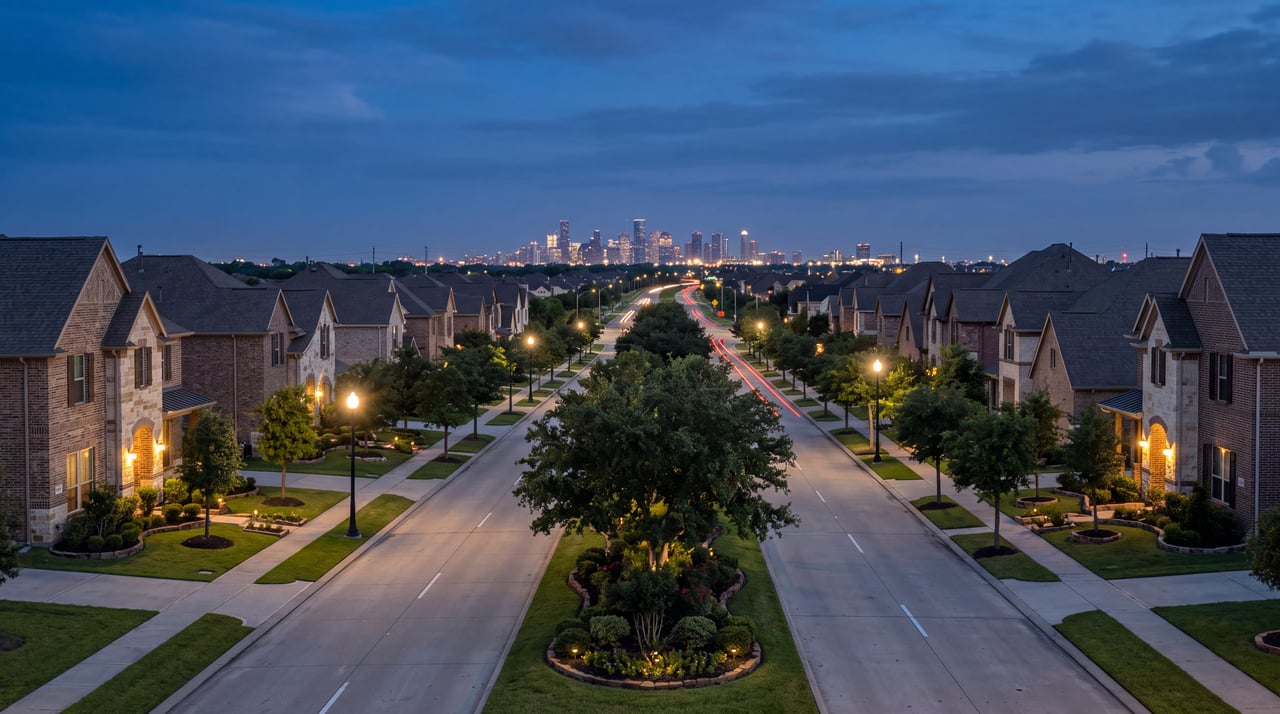
Houston is organized around two major highway loops. Inside Loop 610 is the urban core: walkable, culturally rich, and pricier per square foot. Between Loop 610 and Beltway 8 sits the mid-ring, where neighborhoods like Bellaire and Memorial Villages blend suburban lot sizes with city proximity. Beyond Beltway 8 are the true suburbs: Katy, Cypress, Sugar Land, The Woodlands, Pearland, and more. These areas offer master-planned communities, top-rated independent school districts, and lower price-per-square-foot tradeoffs for significantly longer commutes.
One critical data point: the Houston metro median home value sits at approximately $340K, with inner loop neighborhoods commanding $280 to $565 per square foot while suburbs offer $135 to $220 per square foot. Decide what matters more to you: proximity or square footage. The answer shapes everything else.
Start With Your Work Corridor, Not the Neighborhood
Before you fall in love with a specific ZIP code, identify where you're going to be working. The Texas Medical Center, the Energy Corridor, Downtown, NASA's Clear Lake campus, and Northwest Houston employment hubs all pull commute traffic in completely different directions. Once you know your primary work corridor, suburb choices become much easier. A buyer working at the Medical Center who buys in The Woodlands will spend a significant portion of their life on I-45.
Houston Has No Zoning
This surprises almost every out-of-state buyer. Houston is the largest city in the United States without traditional zoning laws. That means a craft brewery, a townhome development, and a nail salon can legally operate on the same block. In practice, deed restrictions in most established neighborhoods create order, but it's worth understanding that Houston's built environment looks and feels different from cities with strict zoning codes.
The Inner Loop: For Buyers Who Want the City Experience
If you're moving from a walkable city and refuse to give up that lifestyle, the inner loop is your zone. Neighborhoods like the Greater Heights, Montrose, Midtown, and Rice/Museum District offer the closest thing Houston has to a New York or Chicago neighborhood feel. You can walk to coffee, restaurants, and green space. You can commute without a freeway.
The tradeoff is price. Greater Heights home prices were up 4.2% year-over-year as of February 2026, with a median sale price around $678K. Montrose runs slightly lower at around $580K. These are not starter-home markets. They attract buyers who are trading square footage for lifestyle, and they consistently attract buyers who previously lived in coastal cities where these prices would feel like a bargain.
Inner loop neighborhoods like Montrose (Walk Score 87), Midtown (86), West University Place (85), Museum District (79), Rice Military (76), the Heights (75), and EaDo (72) all qualify as walkable or very walkable, which is genuinely rare in Houston and a major draw for out-of-state buyers.
Who the Inner Loop Is Right For
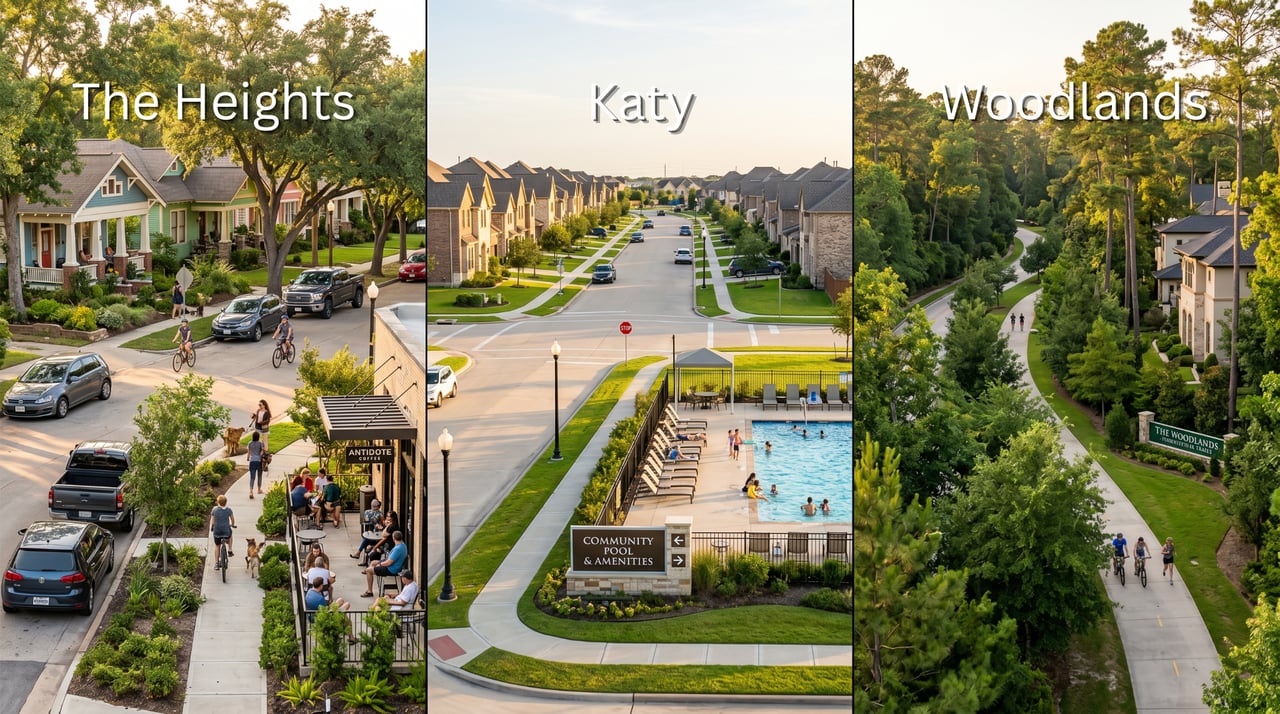
Buyers without school-age children, young professionals, and couples relocating from coastal metros who want to preserve an urban lifestyle tend to be the strongest fit here. The Heights in particular draws buyers who want historic craftsman architecture, weekend farmers markets, trail access along White Oak Bayou, and a short drive downtown. If your children are older or you're a couple without kids, the inner loop is worth serious consideration despite the HISD school district, which is under state oversight through at least 2027.
What Inner Loop Buyers Should Watch
Flood risk varies dramatically block by block inside the loop. Homes near bayous require a closer look at elevation certificates and FEMA flood maps. Work with an agent who knows how to read these before you make an offer. Desirable homes in prime Houston neighborhoods continue to sell competitively, so be ready to move decisively when you find the right property in these areas.
The Suburbs: Where Families With Kids Tend to Land
If top-rated schools are a priority, you're almost certainly looking at suburbs outside Beltway 8. This is where the independent school districts operate. Katy ISD, Cy-Fair ISD, Fort Bend ISD, Conroe ISD, and Clear Creek ISD all have strong academic reputations and are a primary reason families specifically target these zip codes.
Here's a straight comparison of the most-searched Houston suburbs for relocating families:
| Suburb | Median Home Price (2026) | School District | Best For |
|---|---|---|---|
| Katy | ~$336K | Katy ISD | Energy Corridor commuters, new construction buyers |
| The Woodlands | ~$575K | Conroe ISD | Executives, luxury buyers, north-side employment |
| Sugar Land | ~$400K | Fort Bend ISD | Medical Center commuters, diverse communities |
| Cypress | ~$350K | Cy-Fair ISD | Northwest Houston workers, master-planned value |
| Pearland | ~$320K | Pearland ISD | Medical Center commuters, south-side value |
Active listings for single-family homes in the greater Houston area jumped 15.2% year-over-year as of February 2026, which means more options and more negotiating room in most suburban markets right now.
Katy: The West Houston Default for Families
Katy remains one of the top relocation destinations in Greater Houston, and the data backs it up. Katy offers a balance of affordability and school performance, with neighborhoods like Cinco Ranch and Elyson especially popular among young families. One specific advantage for out-of-state buyers: Katy still has active new construction, so you're not limited to resale homes. You can customize a build and avoid competing with other buyers.
Katy home prices have softened from 2025 peaks, sitting around $335,844 as of early 2026. For buyers coming from California or the Northeast, that number for a 4-bedroom home with a yard in a top school district tends to produce visible shock. In a good way.
The commute caveat: if you're working downtown or in the Medical Center, Katy adds significant drive time, especially during peak hours on I-10.
The Woodlands: Premium Master-Planned Living
The Woodlands tops relocation lists for families in 2026, known for its green space, safety, and structured development. It attracts executives, healthcare professionals, and corporate transferees relocating from other states. It's organized into eight villages, each with its own schools, parks, and retail. If you want a suburban experience that feels designed from the ground up, this is the gold standard in Houston.
The premium is real. The Woodlands commands median pricing around $575K to $636K, while Katy offers comparable school quality at $360K to $375K. For buyers prioritizing luxury amenities, trail systems, and long-term property value stability, The Woodlands earns that premium. For buyers who want top schools at a more accessible entry point, Katy is the smarter math.
Cypress: The Northwest Value Play
Cypress is currently the fastest-growing suburb in the region, leading in both inventory and buyer interest. Master-planned communities like Bridgeland have transformed Cypress from a secondary option into a genuine destination suburb. Families are drawn to larger lot sizes, newer homes, and strong community amenities, and Cypress particularly appeals to buyers relocating from states where home prices are significantly higher.
The price-to-space ratio in Cypress is one of the strongest in the metro. You get newer construction, Cy-Fair ISD schools, and more square footage per dollar than nearly anywhere inside Beltway 8. The commute to downtown runs longer, but for buyers working in the northwest employment corridor, Cypress makes the math work comfortably.
Sugar Land and Pearland: The South Side Options That Often Get Overlooked
Out-of-state buyers researching Houston online tend to focus heavily on Katy and The Woodlands. Sugar Land and Pearland deserve equal attention for specific buyer profiles, and they often get undervalued in the broader conversation.
Sugar Land: Diversity, Schools, and Medical Center Access
Sugar Land and Missouri City in Fort Bend County have no single ethnic majority, making them among the most diverse suburbs in the country. Fort Bend ISD is one of the strongest school districts in Texas, and Sugar Land's Town Center area gives the suburb a genuine walkable hub that most Houston suburbs lack. Buyers commuting to the Medical Center find Sugar Land's positioning south of the city significantly more practical than Katy or The Woodlands.
Sugar Land also offers levee-protected flood safety versus reservoir risk, lower total taxes with LID versus MUD structures, and an established town-center feel. For out-of-state buyers prioritizing community diversity along with school quality, Sugar Land is frequently the best all-around fit.
Pearland: The Medical Center Commuter's Suburb
Pearland remains one of the most established suburban markets south of Houston, and its location near the Texas Medical Center makes it especially popular with healthcare professionals. It offers a mix of established neighborhoods and newer construction, a mature retail and restaurant scene, and Pearland ISD schools with a growing academic reputation. Entry price points run lower than Sugar Land, which makes it a strong fit for first-time buyers relocating for Medical Center positions.
Spring Branch and EaDo: The Value Plays for Buyers Priced Out of the Inner Loop
Not every out-of-state buyer has a $650K budget and a desire for suburban square footage. For buyers who want proximity to the city without inner loop pricing, two areas consistently stand out.
Spring Branch sits in northwest Houston and offers what agents describe as the best of both worlds: renovated older homes and new construction, Spring Branch ISD schools (rated A), and proximity to both Memorial Park and the Energy Corridor. Spring Branch is a top choice for those wanting to stay closer to the city, offering a strategic mix of renovated homes and new construction.
East End (EaDo) is Houston's fastest-gentrifying neighborhood. Former warehouse space is converting to breweries, restaurants, and townhomes at a rate that is reshaping what was once an overlooked corridor east of downtown. Walk scores are among the highest in the city outside of Montrose and Midtown. Entry price points still run below the Heights, and buyers willing to get in early are positioning ahead of continued appreciation.
What the 2026 Market Actually Means for Out-of-State Buyers
Here's the honest assessment of buying in Houston right now: it's a buyer-friendly window. Houston home prices were down 2.8% year-over-year as of March 2026, with homes selling after an average of 64 days on the market compared to 47 days last year. That is meaningful leverage for buyers who are prepared and ready to move.
The Houston metro median home price sits around $300K as of early 2026, significantly below Austin at $480K, Denver at $550K, or any coastal market. Combined with no state income tax, the effective buying power of a Houston salary is materially higher than the same salary elsewhere.
Out-of-state buyers often make the mistake of deciding on a neighborhood from Zillow alone. The neighborhoods that look similar on paper can feel completely different in person. Flood risk, specific block quality, proximity to amenities, and school zone lines within the same ZIP code vary more in Houston than in almost any other major city. Work with an agent who knows the specific streets, not just the general area.
I've been guiding out-of-state buyers into Houston neighborhoods since 2013, and the buyers who land in the right fit always have one thing in common: they got honest advice early and didn't make their neighborhood decision based on the prettiest listing photo. If you're relocating to Houston and want a straight conversation about where you should actually be looking, call me directly at (832) 415-9228 or start your Houston home search here.
The right neighborhood is out there. You just need the right data to find it before you fly in.
Explore Houston neighborhoods by area or reach out to Raquel Refuerzo for a personalized relocation consultation.
Related Keywords: best neighborhoods in Houston for families, Houston neighborhoods for out-of-state buyers, where to live in Houston TX, relocating to Houston neighborhood guide, Houston Heights vs Katy vs The Woodlands, best Houston suburbs 2026, Houston relocation guide, Katy TX homes for sale, The Woodlands real estate, Cypress TX neighborhood guide, Sugar Land real estate, Pearland homes for sale, master-planned communities Houston, best school districts Houston, Houston inner loop neighborhoods, moving to Houston from California, Houston home prices 2026, EaDo Houston real estate, Spring Branch Houston homes, Energy Corridor Houston neighborhoods, Houston buyer's guide, out of state home buying Houston, Houston neighborhood comparison, Houston suburb lifestyle guide, where to live near Texas Medical Center