The First-Time Homebuyer's Roadmap for Houston
Every step from pre-approval to closing, plus Texas down payment assistance programs most buyers miss.
July 16, 2026 | By Raquel Refuerzo
Buying your first home in Houston feels like standing at the bottom of a staircase in the dark. You know the destination, but you cannot see the steps. The good news is that the path is far more defined than it looks, and a surprising amount of money is sitting on the table waiting for buyers who know to ask. The City of Houston, Harris County, and the State of Texas all run programs that can cover your down payment and closing costs, and a portion of that money is never repaid.
This is the full sequence, from the day you decide to stop renting to the day you get the keys, written for a Houston buyer in today's market. Mortgage rates are hovering in the low-to-mid 6% range, regional inventory has climbed to roughly 5.7 months of supply, and the median single-family sale price is sitting near $335,000. That combination means you have more choices and more negotiating room than first-time buyers had even two years ago.
Quick Takeaways
- Get a real pre-approval, not a pre-qualification, before you tour a single home.
- As of January 1, 2026, Texas law requires a written buyer representation agreement before an agent shows you homes, so understand it before you sign.
- Down payment assistance in Houston ranges from 3% of your loan up to $50,000 or more, and grants never have to be repaid.
- Houston-specific risks like flood zones, MUD districts, and property tax rates can change your real monthly cost by hundreds of dollars.
- On a $300,000 home, a first-time buyer using assistance can sometimes get to the closing table with only a few thousand dollars.
Step 1: Get Your Finances Honest Before You Shop
Before a lender looks at your file, look at it yourself. Pull your credit from all three bureaus and check your actual score, because the number that determines your rate is rarely the one your credit card app shows you. Most Houston buyers using FHA financing qualify with a score around 580 to 620, and conventional loans reward higher scores with better pricing.
Next, total your monthly debts and compare them to your gross monthly income. Lenders care about your debt-to-income ratio, and many loan programs want your total housing payment plus other debts to stay roughly within 43% of your income. If a car loan or credit card balance is pushing you over, paying it down now can do more for your buying power than waiting another year to save.
Finally, get clear on cash. You need money for a down payment, closing costs, and a small reserve. The number is almost always smaller than people assume, especially once assistance programs are in the picture.
Step 2: Get Pre-Approved, Not Just Pre-Qualified
These two words get used interchangeably, and they are not the same thing. A pre-qualification is an estimate based on what you tell a lender. A pre-approval means the lender has verified your income, assets, and credit and is prepared to lend up to a specific amount. In a market where sellers are weighing real offers, a pre-approval letter is the difference between being taken seriously and being passed over. For a deeper breakdown, see Pre-Approval vs. Pre-Qualification: What Houston Buyers Need to Know.
One important note for Houston buyers: many down payment assistance programs require you to work with a participating lender and to complete a homebuyer education course before you can use the funds. Choosing a lender who already knows these programs saves you from discovering, mid-transaction, that your loan officer cannot deliver the assistance you were counting on.
Step 3: Choose Your Agent and Sign a Buyer Representation Agreement
This step changed in 2026. Under Texas Senate Bill 1968, which took effect January 1, 2026, a real estate agent must have a signed written buyer representation agreement in place before showing you homes. This was reinforced by the national NAR settlement, which reshaped how buyer agents are paid. For first-time buyers, this is a protection, not a hurdle. The agreement spells out in writing what your agent will do for you and how they are compensated, so there are no surprises later.
The takeaway is to choose your agent before you start touring, ask how their compensation works, and read the agreement instead of signing it blind. A strong buyer's agent earns that fee by steering you away from the wrong house, negotiating credits and repairs, and keeping your transaction on track. See Why You Need a Buyer's Agent When Purchasing a Houston Home for the full picture.
Step 4: Tap the Down Payment Assistance Most Buyers Never Claim
This is the step that separates buyers who wait three more years from buyers who close this year. Most first-time buyers in Houston qualify for at least one assistance program, and many qualify for several that can be layered. In Texas, you are considered a first-time buyer if you have not owned a primary residence in the past three years, and veterans are often exempt from that requirement entirely.
Here is how the major programs compare.
Program | Who Runs It | What You Get | The Catch |
|---|---|---|---|
My First Texas Home (TDHCA) | State of Texas | Up to 5% of the loan amount as down payment and closing cost assistance, plus a below-market 30-year fixed rate. Can pair with an MCC. | First-time buyer, minimum 620 score, income and purchase-price limits, education course required. |
My Choice Texas Home (TDHCA) | State of Texas | Up to 5% assistance, open to repeat buyers too. | Same income limits, but repeat buyers do not get the MCC. |
Home Sweet Texas (TSAHC) | State nonprofit | 3% to 5% of the loan as a grant or forgivable second lien. | 620 score, Harris County income limits around $108,540 for 1 to 2 person households and $126,630 for 3 or more. |
Homes for Texas Heroes (TSAHC) | State nonprofit | 3% to 5% assistance plus a free Mortgage Credit Certificate. | Reserved for teachers, first responders, veterans, and similar hero professions. |
City of Houston Homebuyer Assistance (HAP) | City of Houston | Up to $50,000 in forgivable down payment and closing cost help. | Home must pay City of Houston taxes, income limits apply, education required, flood-zone restrictions. |
Harris County Down Payment Assistance (DAP) | Harris County | Down payment and closing cost assistance toward the purchase. | Home must be in unincorporated Harris County, not the City of Houston, with a 5 to 10 year residency requirement. |
Mortgage Credit Certificate (MCC) | State of Texas | A federal tax credit worth a percentage of your annual mortgage interest, for the life of the loan. | First-time buyer or veteran, must be paired with an eligible loan. |
A few things matter here. A grant never has to be repaid. A forgivable loan is forgiven if you stay in the home long enough, often three to ten years depending on the program. And these can stack: a buyer might combine a TSAHC grant with an MCC tax credit, or use city assistance on top of an FHA loan. There are also disaster-recovery and land trust programs in Houston that go well beyond $50,000 for qualifying buyers. For the complete program-by-program guide, read Houston First-Time Homebuyer Programs and Down Payment Assistance.
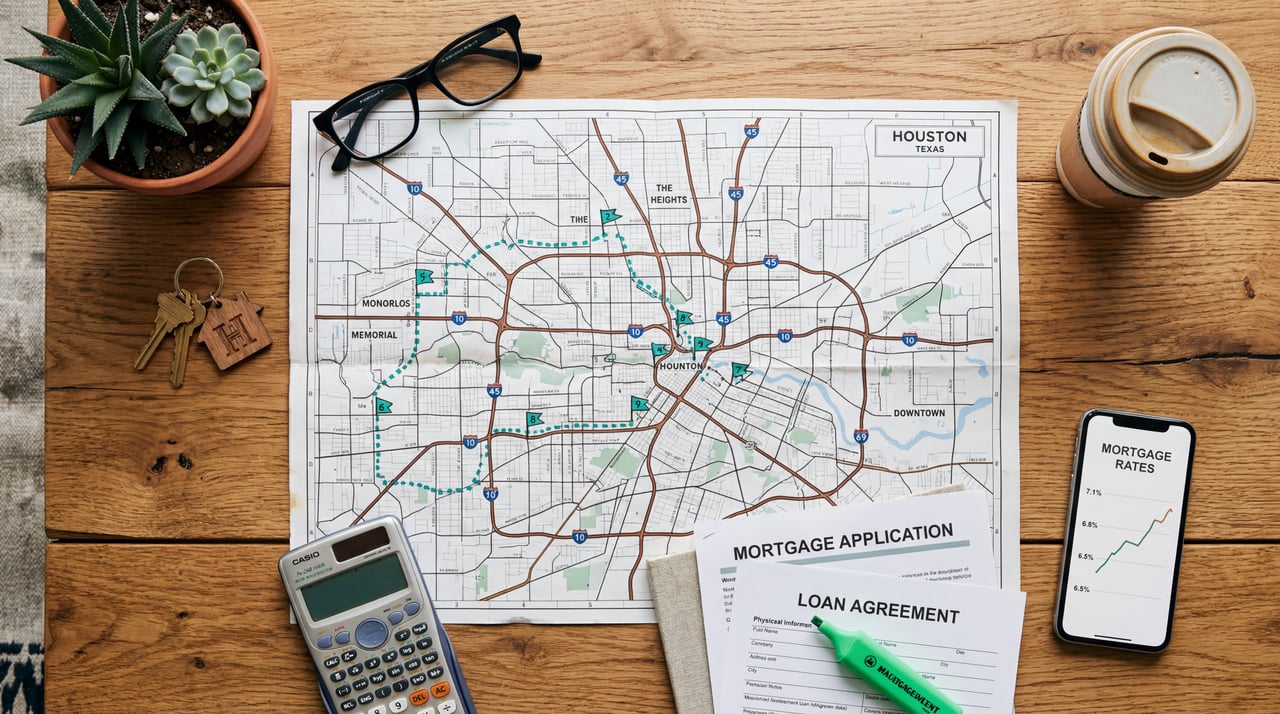
Step 5: Shop With a Houston-Specific Lens
Houston has quirks that buyers from other cities learn the hard way. Three deserve your attention before you fall in love with a listing.
Flood risk is the big one. A home that has never flooded can still sit in a FEMA flood zone, which affects your insurance cost and your loan requirements. Always check the flood designation before you write an offer, and read Flood Zones in Houston: What Buyers Should Know.
Property taxes are the second. Texas has no state income tax, but Houston-area property tax rates are among the higher ones in the country, often in the 2% to 2.5% range of assessed value once you add up city, county, school, and MUD district taxes. That tax bill is built into your monthly payment, so two homes at the same price can carry very different monthly costs. See Houston Property Taxes: What Homeowners Need to Know.
The third is fit. Use this stage to weigh commute, schools, and how a neighborhood actually lives. To pressure-test your budget against real homes, How Much House Can You Afford in Houston in 2026? walks through the math.
Step 6: Make a Competitive Offer and Put Down Earnest Money
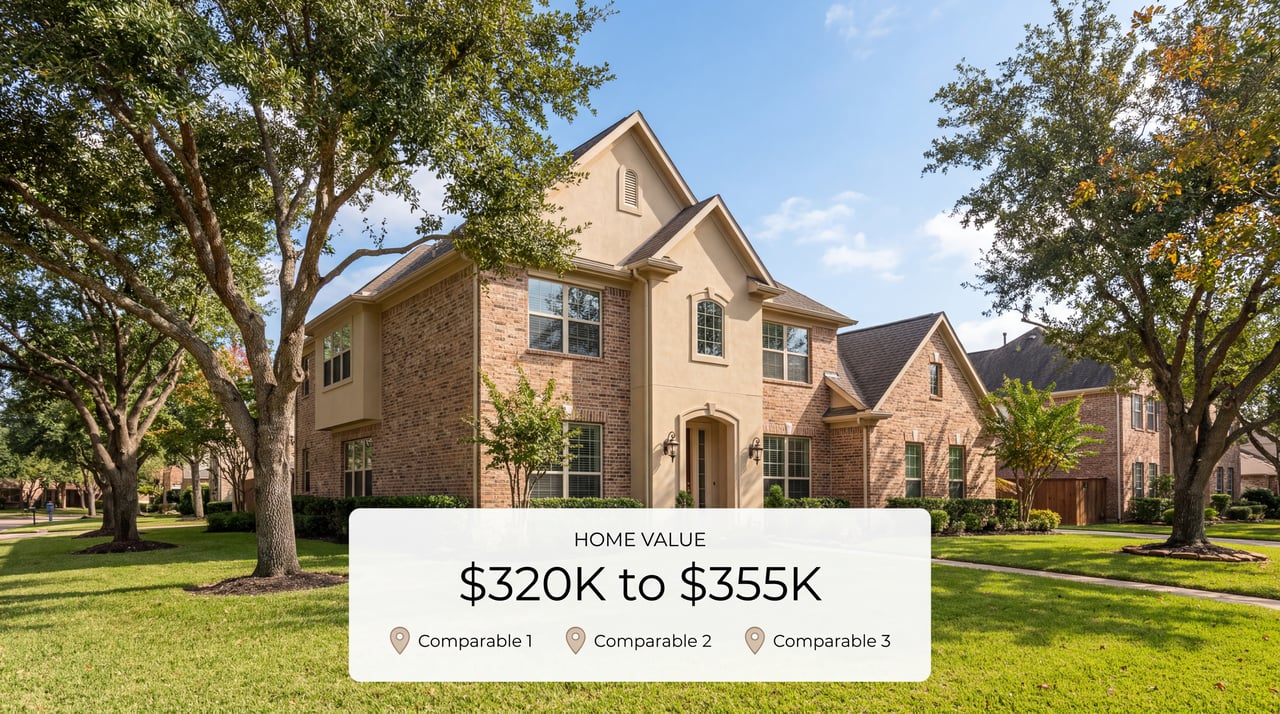
When you find the home, your agent helps you build an offer based on comparable sales, not on the asking price. In today's more balanced Houston market, that often means room to negotiate on price, closing cost credits, or a rate buydown from the seller.
Two Texas-specific items come into play here. Earnest money is a good-faith deposit, usually 1% of the purchase price or so, that signals you are serious. The option fee is a separate, smaller payment that buys you a set number of days to inspect the home and walk away for any reason while keeping your earnest money. Understanding both protects your cash. See Understanding Earnest Money in Houston Real Estate and How to Make a Competitive Offer on a Houston Home.
Step 7: Use Your Option Period for Inspection and Appraisal
Once your offer is accepted, the clock starts on your option period. This is your window to hire a licensed inspector and learn what you are actually buying. Houston homes have predictable trouble spots, from foundation movement in our clay soil to HVAC systems strained by the heat. A good inspection gives you leverage to negotiate repairs or credits, or to walk away if the problems are serious. Read Home Inspection Tips for Houston Buyers before you schedule it.
Around the same time, your lender orders an appraisal to confirm the home is worth what you agreed to pay. If it appraises low, you have options: renegotiate, cover the gap, or use your financing contingency. Your agent and lender guide you through it.
Step 8: Close and Get Your Keys
Closing in Texas happens at a title company, which handles the title search, title insurance, and the transfer of funds. A few days before, you receive a Closing Disclosure that lists your exact cash to close. Review it line by line against your loan estimate. On closing day you sign the documents, your funds are wired, and once the transaction records, the home is yours. For the full walkthrough, see What Happens at Closing in Texas? and budget ahead with Closing Costs for Buyers in Houston: What to Expect.
What This Actually Costs in Today's Market
Numbers make the roadmap real. Here is an illustrative example on a $300,000 Houston home with an FHA loan at roughly 6.5%, before any assistance is applied. These are estimates, not quotes.
Item | Estimated Amount |
|---|---|
Down payment (3.5% FHA) | About $10,500 |
Closing costs (2% to 5%) | About $9,000 to $15,000 |
Estimated monthly payment (principal, interest, taxes, insurance, mortgage insurance) | Roughly $2,300 to $2,500 |
Now layer in assistance. A buyer who qualifies for a 5% TSAHC grant on a $289,500 loan receives roughly $14,000, which can wipe out most or all of the down payment and a chunk of closing costs. Combine that with seller-paid closing credits, common in this market, and the cash you bring to the table can shrink to a few thousand dollars. That is the gap between renting indefinitely and owning this year.
The First-Timer Mistakes Worth Skipping
The most common and costly errors are predictable. Buyers shop before getting pre-approved, then lose the home they want. They assume they make too much or too little to qualify for assistance, and never check. They skip the inspection to win a bidding war that no longer exists in most Houston price points. They forget that property taxes and insurance can swing the monthly payment by hundreds of dollars between two similar homes. And they open a new credit line or change jobs mid-transaction, which can sink a loan days before closing. Avoid all five and you are ahead of most first-time buyers. See 5 Mistakes Houston Home Buyers Make (And How to Avoid Them).
The path from renter to homeowner in Houston is more open right now than it has been in years. Rates have steadied, inventory has grown, and the assistance is real and active in 2026. The buyers who win are simply the ones who follow the steps in order and ask for the money that is already set aside for them.
Related Keywords: first time home buyer Houston, how to buy a house in Houston, Texas down payment assistance, first time buyer programs Houston, Houston home buying process