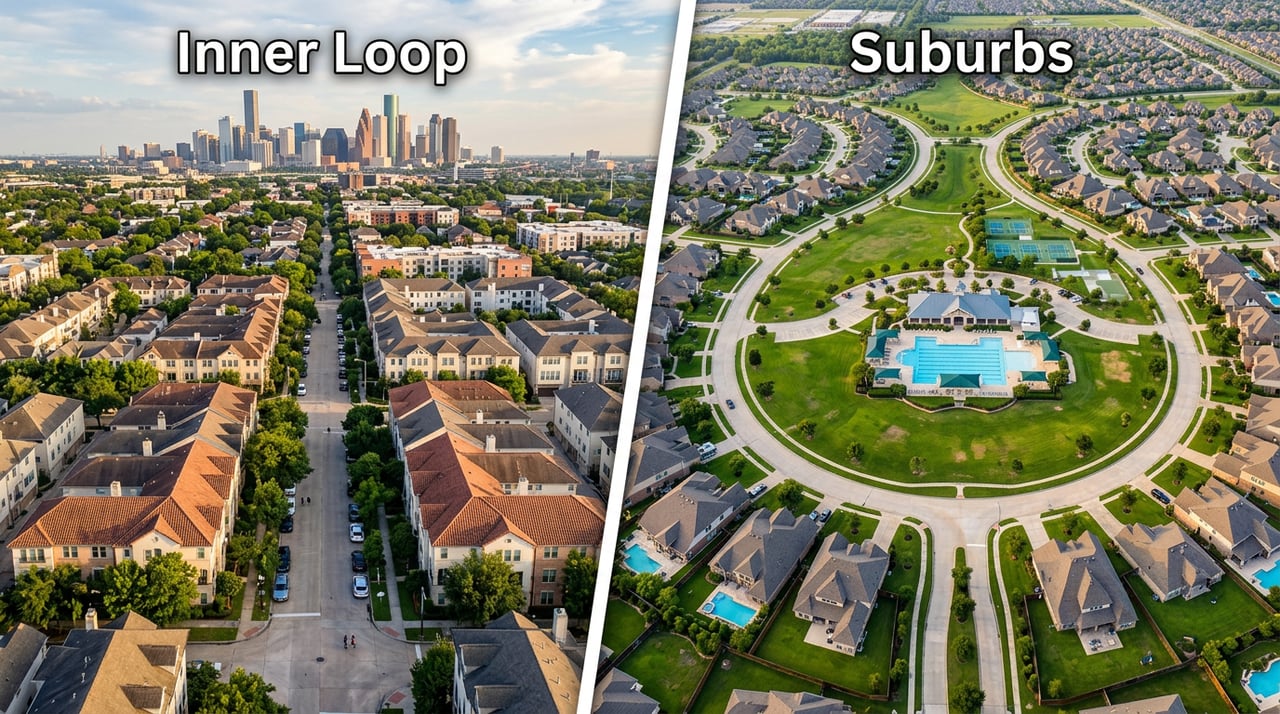
Inner Loop vs. Houston Suburbs: Which Is Right for You as a Relocating Buyer?
Urban walkability or master-planned community -- how to make the call before you book a flight to tour homes
Published: April 20, 2026 | By Raquel Refuerzo
Quick Takeaways
- The 610 Loop is the geographic dividing line in Houston, and where you land relative to it shapes your commute, budget, school options, and daily lifestyle.
- Inner Loop homes cost more per square foot but carry no MUD taxes. Suburban homes offer more square footage for the money, but add-on fees can be significant.
- School districts are a major factor: inner-loop schools fall under HISD (with strong magnet programs), while suburbs like Katy, Cypress, and Fort Bend ISD carry consistent A+ ratings.
- Suburban commutes from Katy or Sugar Land into downtown can run 40 to 70 minutes each way in traffic.
- There is no universally right answer. The best choice depends on where you work, how you want to live, and what your budget actually looks like after taxes and fees.
Most relocators landing in Houston for the first time share one thing in common: they have no frame of reference. You can Google the neighborhoods all you want, but until someone explains the basic geography of how this city is organized, the listings and the commutes and the school district names will not make sense. That is where I start with every client who calls me from out of state.
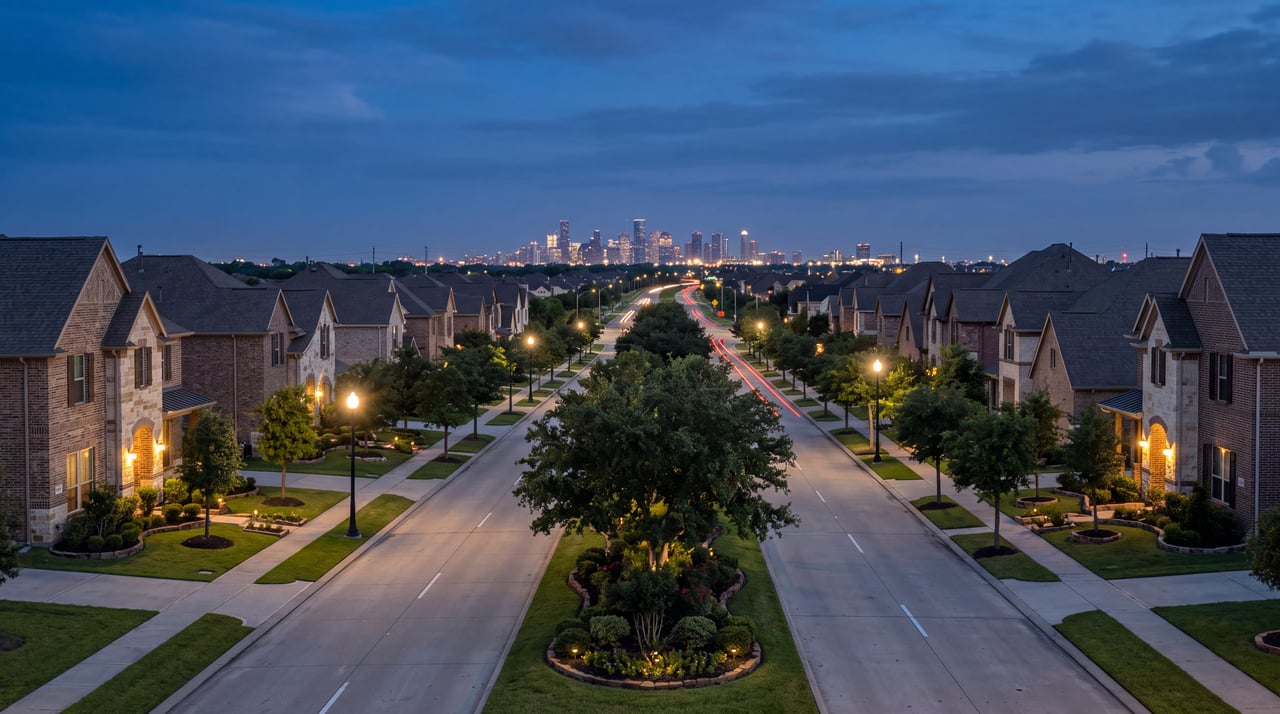
Houston is organized around a series of loops. The most important one for homebuyers is Interstate 610, known simply as "the Loop." It forms a roughly 42-mile circle around the urban core. Everything inside it is the Inner Loop. Everything outside it, from Katy to Sugar Land to Cypress to Pearland, is the suburbs. Where you land relative to that line will shape your commute, your monthly costs, your school zone, and how you spend your weekends. This post breaks down both sides so you can make a real decision before you ever board a plane.
What Does "Inner Loop Houston" Actually Mean?
The Inner Loop refers to neighborhoods inside I-610. When people say it, they usually mean places like The Heights, Montrose, Midtown, the Museum District, Rice Military, EaDo, and Bellaire. These are older, established neighborhoods with a mix of historic bungalows, new construction townhomes, and high-rise condos.
The Inner Loop does not have a single personality. The Heights skews toward young professionals and families with dogs. Montrose is artsy, walkable, and LGBTQ+ friendly. Midtown is dense and social, popular with medical professionals and recent transplants. EaDo is still gentrifying and offers the lowest entry prices inside the loop. Each neighborhood has its own character, but they share some practical traits worth knowing.
No MUD Taxes
Most Inner Loop neighborhoods sit outside of Municipal Utility Districts, which are special taxing entities that fund water, sewer, and drainage infrastructure in newer suburban developments. In parts of Katy, Cypress, and Spring, MUD rates can add $0.30 to $1.00 per $100 of assessed value on top of your base property tax rate. On a $400,000 home in a high-MUD suburb, that adds $1,200 to $4,000 in annual taxes. Inner Loop buyers generally avoid this cost entirely.
Walkability and Transit
The Inner Loop has the most walkable neighborhoods in Houston. The METRO Red Line light rail connects Downtown, Midtown, the Museum District, and the Texas Medical Center. If you work at the Medical Center or downtown, living near a rail corridor is a real advantage. Midtown and Montrose also have bike lane access. This does not mean you ditch your car entirely in Houston -- most Inner Loop residents still drive -- but options exist here that do not exist in the suburbs.
Cultural Access
Houston has one of the best cultural footprints of any U.S. city, and most of it sits inside the loop. The Museum District is home to 19 institutions, including the Houston Museum of Natural Science and the Museum of Fine Arts Houston. The James Beard-nominated restaurant scene is concentrated in Montrose and Midtown. If weekends for you mean farmers markets, galleries, and walkable brunch spots, the Inner Loop delivers.
What Is the Suburban Houston Experience?
The suburbs start outside Beltway 8, which is the next major loop beyond I-610. The dominant suburban markets in Greater Houston are Katy, Sugar Land, Cypress, Pearland, Spring, and Richmond. Each has its own identity, but they share a common profile: newer construction, master-planned communities, larger lots, and highly rated school districts.
I work with buyers across all of these markets. The experience is different from the Inner Loop in very practical ways.
More Space, Different Cost Structure
You get significantly more square footage for your dollar in the suburbs. Inside the 610 Loop, you are paying for the land and the lifestyle. In the suburbs, you are paying for the square footage and the schools. A $450,000 budget in Katy or Cypress gets you a 2,500 to 3,200 square foot home in a master-planned community with a pool and a walking trail. That same budget inside the loop buys you a 1,400 to 1,800 square foot townhome, sometimes with shared walls and no yard.
The catch is the total cost of ownership. Suburban communities like Katy, Sugar Land, and Pearland offer more space at lower prices, but MUD taxes and HOA fees can add $300 to $600 per month to your costs. Run those numbers before you compare sticker prices.
School Districts
This is the biggest practical driver of suburban demand, and it matters even if you do not have school-age children. Strong school districts increase resale velocity and protect your long-term asset value. In 2026, homes in top-rated school districts are selling 15% faster than comparable homes in lower-rated districts.
Katy ISD, Fort Bend ISD, and Cy-Fair ISD all carry A+ state ratings. Every Inner Loop neighborhood falls within Houston ISD, which is currently under state oversight. HISD has standout magnet programs, including DeBakey High School for Health Professions and Carnegie Vanguard High School, but the district instability is a real consideration for families who want predictability.
Commute Reality
This is where many relocators underestimate what they are signing up for. Houston is spread out across a large area. Residents in the outskirts of city limits may live up to 30 miles from downtown. The city of Katy is approximately 28 miles west of Houston, and the drive into Houston takes about 40 minutes, but can take 50 minutes or more with traffic.
True suburbs outside Beltway 8 carry trade-offs including 35 to 70 minute commutes and near-total car dependency. Toll roads are part of the suburban commute picture. Common daily toll costs for suburban commuters range from roughly $4 to $15 per day depending on the route and congestion pricing, adding up to $150 to $300 per month in tolls alone. Factor that in alongside gas and maintenance before you make your location call.
How Do the Numbers Compare? Inner Loop vs. Suburbs in 2026
Here is a side-by-side look at the key variables that shift based on where you buy:
| Factor | Inner Loop | Houston Suburbs |
|---|---|---|
| Typical price per sq ft | $200 - $300+ | $130 - $180 |
| Avg sq footage at $450K | 1,400 - 1,800 sq ft | 2,500 - 3,200 sq ft |
| MUD taxes | None in most areas | $1,200 - $4,000/year |
| HOA fees | Rare or low | $100 - $400/month common |
| Daily commute (to downtown) | 10 - 25 min | 40 - 70 min |
| Monthly toll estimate | Minimal | $150 - $300 |
| School district | Houston ISD (HISD) | Katy, Fort Bend, Cy-Fair ISD |
| Walkability | Moderate to High | Low |
| Lot size | Smaller, townhome common | Larger, yard typical |
| New construction availability | Limited | Abundant |
Sources: HAR, Numely, relocatemetx.com, absolutepropertieshtx.com
What Should Drive Your Decision as a Relocating Buyer?
This is the part of the conversation I have with every out-of-state buyer who calls me before they book their flight. The answer to "Inner Loop or suburbs?" is almost always the same three questions.
Where Is Your Office?
If you are working in the Texas Medical Center or downtown, the Inner Loop is worth the higher price per square foot. A 15-minute commute versus a 55-minute commute is not a lifestyle preference, it is a quality-of-life issue. On the flip side, if you land a job in the Energy Corridor or a company campus in Katy, the suburbs may put you closer to work than any Inner Loop address would.
I worked with a relocation buyer a few years back who was coming from New York to take a position at a hospital in the Medical Center. She had assumed Houston would be like most cities she knew, where living close to work and living in a nice neighborhood were two separate goals. When I showed her the Museum District and Midtown, she realized she could have both. She bought inside the loop and has not regretted it.
Do You Have Children, or Are You Planning To?
If school district stability is a priority right now, the suburbs give you more certainty. Katy ISD, Fort Bend ISD, and Cy-Fair ISD are among the top-rated districts in Texas with consistent performance records and new campus investment. HISD does have strong options, particularly its magnet school network, but the district-level environment requires more due diligence and a willingness to research individual schools rather than relying on a district-wide reputation.
If you do not have children and school district ratings are not a current driver, the Inner Loop gives you lifestyle advantages that the suburbs do not: walkability, cultural access, and a shorter commute to most major employment centers.
What Does Your Budget Actually Look Like After All Fees?
Do not compare Inner Loop prices to suburban prices at face value. The real comparison includes property taxes, MUD fees, HOA dues, toll costs, and commuting expenses. A home listed at $380,000 in a high-MUD suburb can have a higher true monthly cost than a $430,000 townhome inside the loop when you factor in the fee structure. I run these numbers for every buyer I work with as part of the search process. It changes the conversation every time.
For a deeper look at what your budget actually buys in today's market, my post on how much house you can afford in Houston in 2026 walks through the full cost picture with current rates and fee data.
Is There a Middle Ground?
Yes, and it is worth knowing about. The area between I-610 and Beltway 8 functions as a transition zone. Neighborhoods like Bellaire, Memorial Villages, and Spring Branch sit in this mid-ring. You get larger lots than most Inner Loop properties, proximity to the Energy Corridor and Galleria, access to Spring Branch ISD (rated A), and commute times that are shorter than the true suburbs. These areas tend to carry higher price tags because the trade-off profile is more balanced, but they are worth considering if you want both space and reasonable access to the urban core.
The Bottom Line for Relocating Buyers
Houston does not ask you to choose between a good home and a manageable life. Both the Inner Loop and the suburbs offer strong options. But they serve very different buyers, and the wrong choice for your situation is a real and expensive mistake when you are moving from out of state.
The Inner Loop is the right call if you want walkability, a short commute to downtown or the Medical Center, and a culturally active lifestyle, and you are comfortable with older housing stock and more limited square footage for the price. The suburbs are the right call if you need top-rated schools, more space for your budget, newer construction, and you are building your life around a car-dependent community with master-planned amenities.
If you are relocating to Greater Houston and want to talk through the decision before your home search trip, reach out to me directly. I work with buyers across both markets and I will tell you the truth about where you will be happiest before you fall in love with the wrong zip code. You can also reach me by phone at (832) 415-9228.
Browse the Houston neighborhoods guide on my site to start getting a feel for specific communities across both markets.
Related Keywords: Houston inner loop vs suburbs, living inside 610 loop Houston, best Houston suburbs to buy a home, Heights vs Katy TX, urban vs suburban Houston relocation, moving to Houston from out of state, Houston relocation guide, Katy TX real estate, Sugar Land TX homes for sale, Cypress TX home buying, Houston commute times by neighborhood, MUD taxes Houston suburbs, Houston ISD vs Katy ISD, best neighborhoods Houston relocators, Greater Houston home buying guide, Houston inner loop neighborhoods, master-planned communities Houston, Houston suburb home prices 2026, relocating to Houston buyer guide, homes for sale Houston TX, Houston real estate agent relocation, Pearland TX real estate, Spring Branch Houston homes, Bellaire TX neighborhood guide, Houston buyer's agent